





DataCore
77views
With DataCore Puls8 officially launching on January 26, 2026 (with GA release notes published on January 21, 2026), the key question for OpenEBS users is whether the commercial offering is worth the subscription cost. The answer ultimately depends on your position along the operational complexity spectrum—and the scale of stateful workloads you’re running in production.
Quick Background Recap
OpenEBS is a mature, open-source project under the Cloud Native Computing Foundation, currently progressing toward Incubation status. It delivers container-native storage (CNS) for Kubernetes by transforming local node disks into persistent volumes through CSI drivers.
The platform supports two primary models. The first is Local Persistent Volumes (Local PV), which includes options like hostPath, LVM, and ZFS for direct, non-replicated storage access. The second is Replicated Persistent Volumes, powered by Mayastor, which enables synchronous replication and high availability.
Mayastor serves as the high-performance data engine within OpenEBS. It is built on technologies such as NVMe-oF (NVMe over Fabrics) and the Storage Performance Development Kit (SPDK), allowing it to deliver near bare-metal disk performance while maintaining data protection.
As a free and community-driven solution, OpenEBS is widely adopted across a range of environments—from development and testing clusters to production-grade database workloads.
DataCore Puls8 is DataCore’s commercial layer built directly on top of OpenEBS. It’s not a fork. It uses the exact same data engines and retains full compatibility. What Puls8 adds is a management plane with a GUI, automated node failure handling, integrated observability, and enterprise support. DataCore has been in the software-defined storage business since 1998, and Puls8 represents their extension into container-native environments.
Architecture Comparison
Both solutions are fully Kubernetes-native and use CSI for provisioning Persistent Volumes and Claims. The architectural divergence is in what sits above the data engines.
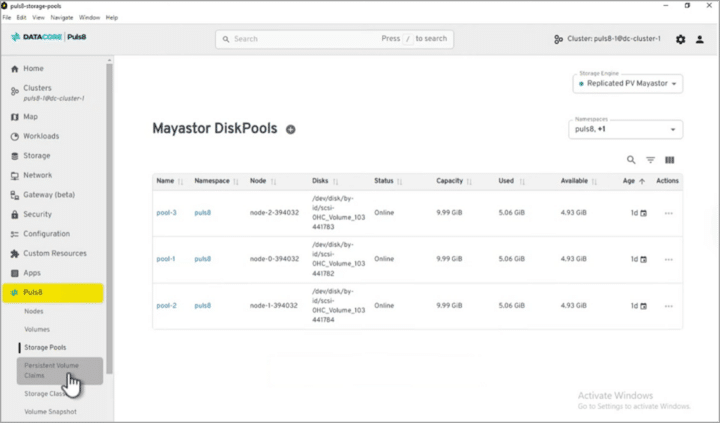
OpenEBS provides a robust foundation with its control plane, data engines—including Mayastor for replication—and Kubernetes operators. All configuration is handled declaratively using YAML and Custom Resource Definitions (CRDs), giving users full control over storage behavior.
Its storage engines are divided into two main categories. Local Persistent Volumes (Local PV) offer non-replicated, low-latency storage, while Replicated Persistent Volumes—powered by Mayastor—enable synchronous replication over NVMe-oF/TCP or NVMe-oF/RDMA. This architecture is both powerful and flexible; however, as environments scale—particularly beyond 30 nodes with mixed workloads—the operational overhead increases. In larger deployments, users often find that troubleshooting replication issues or managing a growing number of storage classes via kubectl can become time-consuming.
DataCore Puls8 builds on this foundation without replacing it, introducing an additional layer: a Management Plane that sits above the OpenEBS control plane. This layer delivers a graphical interface for storage lifecycle management, built-in observability dashboards, and automated node failure protection. It can handle high-availability rescheduling and StatefulSet restarts without requiring manual intervention.
The resulting three-layer architecture—Management Plane, Control Plane, and Data Engines—remains fully containerized, eliminating the need for external appliances. For administrators who have experienced manual recovery tasks such as cordoning nodes, evicting pods, and verifying volume reattachment after failures, the automated failure protection alone stands out as a major improvement.
Performance
Both solutions are capable of delivering NVMe-class performance when backed by local SSDs or NVMe drives. Puls8 places a strong emphasis on ultra-low latency for demanding workloads such as databases, AI/ML, and analytics, and highlights benchmark results showing performance gains—for example, outperforming cloud-based persistent disks when combined with local SSDs. Meanwhile, OpenEBS Mayastor is already optimized with SPDK to achieve high IOPS and low latency, but Puls8 further refines and validates this performance for greater consistency in enterprise environments.
From a practical standpoint, Puls8 does not introduce significant overhead to the existing OpenEBS data path. Its management plane operates independently, ensuring that storage I/O performance remains unaffected.
For most teams, the key performance consideration is not raw throughput, but recovery speed. Specifically, how quickly volumes can be reattached and pods rescheduled after a failure. In this area, Puls8’s automated failover capabilities can reduce downtime by minutes compared to the manual recovery processes typically required with OpenEBS alone.
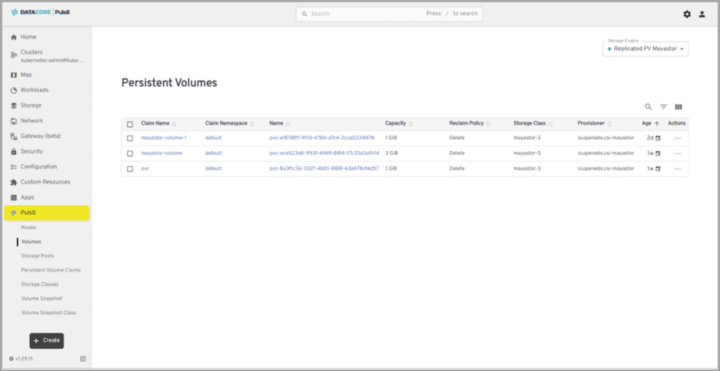
Puls8’s graphical interface offers clear visibility into the entire storage topology, including volume placement across nodes, replication status, capacity usage, and overall health—all without the need to run multiple kubectl commands or interpret raw YAML output.
For teams with varying levels of Kubernetes expertise, or in organizations where storage administration and platform engineering are handled by different roles, this significantly lowers the barrier to entry and simplifies day-to-day operations.
Support and Cost
OpenEBS is a free, community-driven solution. While DataCore offers optional SLA-based support for OpenEBS, most users depend on GitHub issues, Slack communities, and documentation for assistance. Although the community is active, response times can be unpredictable—making critical production troubleshooting, especially during off-hours, a risky situation many teams prefer to avoid.
In contrast, Puls8 includes DataCore’s 24/7 enterprise support backed by SLAs. Pricing is not publicly disclosed and typically requires direct engagement with DataCore, often scaling based on the number of nodes. DataCore positions Puls8 with a total cost of ownership (TCO) advantage, arguing that operational efficiencies—driven by its GUI, automated failover, and integrated tooling—can offset subscription costs. This is particularly relevant for larger environments, such as clusters with 20 or more nodes, where managing OpenEBS manually can consume significant engineering time.
Ultimately, whether this cost-benefit equation holds true depends on the size of your team and your level of Kubernetes expertise.
When to Choose OpenEBS vs Puls8
OpenEBS is a strong fit for teams with deep Kubernetes expertise who value the flexibility of open-source solutions. It works particularly well for smaller clusters, development or testing environments, or for teams that prefer building and managing their own storage tooling. With no licensing costs and backing from the Cloud Native Computing Foundation, OpenEBS offers full control without tying you to a specific vendor roadmap.
Puls8, on the other hand, becomes compelling when operational complexity starts to slow teams down. In production environments running stateful workloads—such as PostgreSQL, MongoDB, Cassandra, or AI/ML pipelines—where uptime is critical, the time spent on manual storage operations can quickly add up. In these cases, Puls8’s automation, GUI, and enterprise support make it a strong candidate. It’s also a practical choice for organizations that require vendor-backed SLAs for compliance, or where storage administrators are not deeply familiar with Kubernetes and benefit from a more accessible interface. Teams already using DataCore’s storage solutions may also find the ecosystem integration advantageous.
As a general rule of thumb, if you’re managing fewer than 10 stateful workloads and have a Kubernetes-proficient team, OpenEBS is likely sufficient. Beyond that—especially when service-level commitments are involved—the operational efficiency gained from Puls8’s automation and support can begin to outweigh the cost of a subscription.
Final Words
Both OpenEBS and Puls8 solve the same core problem – provide fast, resilient persistent storage in Kubernetes without legacy SAN/NAS overhead. Puls8 doesn’t replace OpenEBS, but rather it elevates it for environments where “good enough” isn’t sufficient for production stateful workloads. If you’re already running OpenEBS successfully and don’t need the extras, stick with it. But for teams pushing Kubernetes into mission-critical territory, Puls8’s enhancements in management, resilience, and support make it a compelling upgrade.
Source links:
- Official Puls8 product page: https://www.datacore.com/products/puls8
- Persistent Storage for Kubernetes solution page: https://www.datacore.com/solutions/persistent-storage-for-kubernetes
add a comment

Azure Devops 22.2 ISO
Azure DevOps 22.2 (that is, Azure DevOps Server 2022.2) is the latest point release in the 2022 server line, delivering new features from...

Azure DevOps Server 2022.2 Downloads
Azure DevOps Server allows you to self host the same modern dev services available in Azure DevOps, including Boards (planning and...
Microsoft DevOps Server 2022 ISO
If you're looking to build a powerful on-premises DevOps environment, Microsoft DevOps Server 2022 (formerly Azure DevOps Server / TFS)...

TrueNAS Responds to Community Concerns With New Community and Enterprise Vision
After discussions within the community about shifting the TrueNAS build infrastructure to internal systems, iXsystems released a blog post titled...