



Run Your Own Private Cloud on Proxmox: Deploy Alpine Nextcloud LXC with the Proxmox Community Script
2.1kviews
Introduction
Google Drive, OneDrive, Dropbox — you’ve been feeding your files, documents, photos, and arguably some of your most sensitive personal and professional data into cloud platforms you don’t own, can’t audit, and have absolutely no control over. At some point, most IT professionals have the same realization: why am I doing this when I have a perfectly good Proxmox server sitting right there?
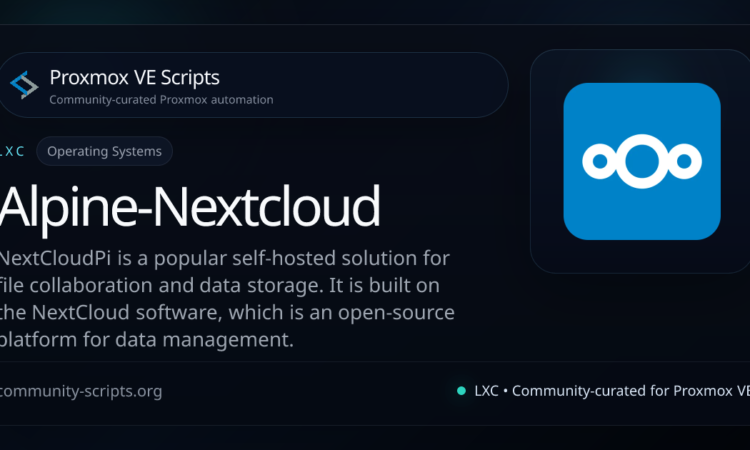
Nextcloud is the answer — a mature, open-source platform that turns your own hardware into a full-featured private cloud. And the Proxmox Community Scripts project makes deploying it genuinely trivial: a single command spins up an Alpine Linux LXC container with Nextcloud fully configured, running on the leanest possible OS foundation, without any of the manual dependency juggling that used to make Nextcloud setup a weekend project.
In this guide, we’ll unpack what Nextcloud actually is, why the Alpine Linux variant is the smart choice for resource-conscious Proxmox deployments, how the community script handles the heavy lifting, and why owning your own cloud matters more than ever in 2025.
| 💡 Quick Context: The Alpine-Nextcloud community script is flagged as AlpineAdvanced mode in the Proxmox Community Scripts catalog, meaning it installs Nextcloud natively via Alpine Linux packages — delivering faster creation time and minimal resource usage compared to Debian-based deployments. |
What Is Nextcloud?
Nextcloud is an open-source, self-hosted file sync and collaboration platform that started as a fork of ownCloud back in 2016 when founder Frank Karlitschek and a large portion of the core developer team left to build something without commercial restrictions. In the years since, Nextcloud has grown far beyond simple file storage into what is genuinely the most comprehensive self-hosted productivity suite available today.
At its foundation, Nextcloud provides file synchronization across all your devices — desktop, mobile, and web — with desktop clients for Windows, macOS, and Linux, and mobile apps for iOS and Android that handle automatic photo backup, offline file access, and background sync. The web interface is clean, fast, and familiar enough that non-technical users can navigate it without a manual.
But the real depth of Nextcloud lives in its app ecosystem. Beyond core file storage, you can extend a Nextcloud instance into a complete productivity platform with tools for real-time document editing, video conferencing, calendar and contacts sync, project management, password management, and even AI-powered features — all running on infrastructure you control.
| 📊 By the Numbers: Nextcloud is trusted by thousands of organizations globally, is widely considered the best overall self-hosted Google Drive alternative in 2025, and offers over 400 community and official apps through its integrated App Store. |
Why Alpine Linux? The Smart Choice for Proxmox Containers
The community-scripts.org Alpine-Nextcloud script deploys Nextcloud on Alpine Linux — a security-oriented, lightweight Linux distribution that is the go-to base for containers where resource efficiency and a minimal attack surface matter. This is a deliberate, meaningful choice, not just a default.
A standard Debian or Ubuntu-based Nextcloud LXC will consume considerably more RAM and disk at idle. Alpine’s entire base system is built around musl libc and BusyBox, keeping the runtime footprint dramatically smaller. For Proxmox deployments where you’re running multiple containers on shared hardware, this difference is real and measurable.
Alpine vs Debian for Nextcloud LXC: At a Glance
| Attribute | Alpine Linux | Debian/Ubuntu |
| Base OS size | ~8 MB | ~120+ MB |
| Idle RAM usage | Significantly lower | Higher baseline |
| Container creation time | Faster — package-based install | Slower — more dependencies |
| Package manager | apk (Alpine Package Keeper) | apt / apt-get |
| Security model | Minimal attack surface by design | Broader package surface |
| libc | musl libc | glibc |
| Nextcloud install path | Native apk packages | Manual/script install |
| Upgrade path | apk upgrade + major version steps | apt upgrade |
| ⚠️ Alpine Note: Because Alpine uses musl libc instead of glibc, some Nextcloud add-ons (notably the built-in Collabora CODE document editor AppImage) do not run natively on Alpine. For collaborative document editing, you’ll want a separate Collabora or OnlyOffice container connected to your Alpine Nextcloud instance via integration settings. |
Deploying with the Proxmox Community Script: One Command
The community-scripts.org project — the community-maintained repository of 400+ Proxmox helper scripts originally created by tteck and now actively maintained in his memory — includes the Alpine-Nextcloud script as a featured, actively maintained deployment. Running it in a Proxmox VE Shell session creates a fully configured Alpine Linux LXC with Nextcloud installed, the database configured, services started, and HTTPS enabled — ready to log into.
To deploy, open your Proxmox VE Shell and run:
bash -c “$(curl -fsSL https://raw.githubusercontent.com/community-scripts/ProxmoxVE/main/ct/alpine-nextcloud.sh)”
| 🔒 Security Check: Always verify the URL before executing any remote shell script. Confirm it resolves to the official community-scripts/ProxmoxVE GitHub repository. Beware of copycat sites that mirror community-scripts.org — the project itself warns about these. |
What the script sets up automatically inside the Alpine LXC:
- Alpine Linux base OS — minimal, hardened, current stable release
- PHP and PHP-FPM — configured with appropriate modules for Nextcloud (opcache, APCu, Redis support, required extensions)
- Nginx — configured as the web server with FastCGI passthrough to PHP-FPM
- MySQL/MariaDB — configured as the Nextcloud database backend
- Nextcloud Hub — installed via apk (Alpine’s native package manager) with additional Nextcloud packages
- Redis — installed for file locking and session caching, preventing data corruption under concurrent access
- HTTPS — enabled by default on the container, so your Nextcloud instance is accessible via HTTPS immediately
- Services configured and started — all components running and wired together before the script exits
| 🔑 Getting Credentials: On the Alpine-Nextcloud script, the admin username and password are retrieved by running the script again inside the LXC shell after installation completes. This is specific to the Alpine install mode — note this before you close the terminal after deployment. |
Key Highlights
☁️ Complete Private Cloud — Files, Sync, Sharing
- Full file synchronization across desktop (Windows, macOS, Linux) and mobile (iOS, Android) with automatic photo/video backup from your phone
- Granular sharing controls: password-protected links, expiry dates, download restrictions, read-only vs. edit permissions — all on your terms
- File Drop feature acts as a self-hosted WeTransfer alternative, letting external parties upload files to your Nextcloud without needing an account
- Version history on all files — recover previous versions at any point without needing a separate backup tool for accidental overwrites
- External storage mount support: connect S3, SFTP, SMB, WebDAV, and other backends so Nextcloud becomes a unified interface for all your storage
🛠️ 400+ App Ecosystem — Build Your Own Productivity Suite
- Nextcloud Talk — fully self-hosted, end-to-end encrypted video conferencing, voice calls, and team chat with screen sharing and SIP integration
- Nextcloud Calendar and Contacts — CalDAV/CardDAV sync that works natively with iPhone, Android, Thunderbird, and Outlook via plugins
- Nextcloud Deck — a Trello/Kanban-style project board for managing tasks and projects without leaving your instance
- Nextcloud Mail — a webmail client that connects to your existing IMAP/SMTP accounts within the Nextcloud interface
- Nextcloud Photos — a private Google Photos alternative with album organization, shared albums, and optional AI-powered facial recognition
- Password manager, music streaming, RSS reader, bookmarks, recipe manager, whiteboard — the app catalog covers nearly every productivity need
📝 Real-Time Document Collaboration — The Office Suite Layer
- Nextcloud Office (powered by Collabora Online, the LibreOffice-based editor) supports real-time multi-user editing of DOCX, XLSX, PPTX, and ODF files
- OnlyOffice integration is a popular alternative for teams that prefer a more Microsoft Office-like interface for co-editing
- For Alpine-based deployments, document editing requires a separate Collabora or OnlyOffice container connected via integration settings — the Alpine LXC handles Nextcloud itself cleanly
- Version history, commenting, and suggested changes are all supported inline in the document editor
🔐 Security Features Built In — Not Bolted On
- End-to-end encryption for sensitive files — encrypt locally before upload so even the server administrator cannot read the content
- Server-side encryption for at-rest protection — configurable per storage backend
- Two-factor authentication support: TOTP apps (Google Authenticator, Authy), WebAuthn/FIDO2 hardware keys, and backup codes
- Brute-force protection built into the core — automatic lockout after repeated failed login attempts
- Full audit logs and admin panel security scan: Nextcloud’s built-in security scanner checks your configuration against best practices and flags issues
- GDPR compliance by design — you control data residency, retention policies, and deletion with no third-party dependencies
🏠 Home Lab & Alpine Efficiency Advantages
- The Alpine-Nextcloud LXC runs with as little as 1 GB RAM and 2 GB disk in the default install — leaving substantial headroom on shared Proxmox hardware
- Native apk package management means Nextcloud updates follow the Alpine package lifecycle — structured, predictable, and manageable from the command line
- Re-running the community script inside the LXC shell launches a management menu for retrieving credentials, updating the installation, and performing maintenance tasks
- OPcache and APCu caching are configured out-of-the-box, giving the PHP application significant performance improvements without manual tuning
Why It Matters
The case for self-hosting your own cloud in 2025 is stronger than it has ever been, and the reasons extend well beyond “I don’t trust big tech” (though that’s a perfectly valid position to hold).
The Privacy and Compliance Reality
In 2025 and 2026, EU regulatory bodies have issued guidance specifically questioning whether US-based cloud services can genuinely comply with GDPR, given the reach of US government surveillance laws. For organizations operating under GDPR, HIPAA, or similar frameworks, this isn’t a theoretical concern — it’s a compliance liability. A self-hosted Nextcloud instance on your own infrastructure sidesteps this issue entirely. Your data never leaves your jurisdiction, your control, or your audit trail.
The Economics Are Compelling
Google Workspace Business Standard runs $12.50/user/month. Microsoft 365 Business Standard is $12.50/user/month. For a 50-person team, that’s $7,500 per year — and those costs scale linearly with headcount. A self-hosted Nextcloud instance on a modest server handles that same team for the flat cost of the hardware and electricity. The break-even point for most organizations is well under two years, and after that the savings compound indefinitely.
Vendor Independence Is Not a Niche Concern
Cloud providers change pricing, deprecate features, alter terms of service, and occasionally go down at the worst possible moment. Anyone who has had a critical workflow disrupted by a Google Drive outage, a Dropbox pricing change, or a surprise API deprecation understands the operational risk of full vendor dependency. Self-hosting Nextcloud eliminates that dependency at the infrastructure level. Your cloud is up when your Proxmox node is up — which is something you control.
The Learning Value for IT Professionals
Deploying and operating a Nextcloud instance on Alpine Linux in a Proxmox LXC is genuinely educational. You get hands-on experience with PHP application stack management, Nginx configuration, MariaDB administration, Redis caching architecture, reverse proxy setup, SSL certificate management, and Linux container operations — all on a real, production-quality application. This is the kind of practical experience that directly translates to enterprise infrastructure work, and you’re learning it on a platform that also saves you a cloud subscription.
Post-Install: Setting Up Your Nextcloud Instance
Once the community script finishes, your Nextcloud instance is accessible at https://<container-ip>. Here are the priority steps for a clean, production-quality setup:
Immediate Setup Steps
- Retrieve credentials: Run the script again inside the LXC shell — it will display the admin username and password for initial login
- Log in and complete the setup wizard: Verify the initial admin account is working and the Nextcloud Hub welcome screen loads correctly
- Add your domain: Edit /usr/share/webapps/nextcloud/config/config.php to add your domain or LAN hostname to the trusted_domains array — required before you can access Nextcloud via anything other than the raw IP address
- Install a reverse proxy: Set up Nginx Proxy Manager or Caddy on a separate LXC to handle SSL termination and route your domain to the Nextcloud container — this is the cleanest way to expose Nextcloud externally
- Configure background jobs: Set Nextcloud to use system cron rather than AJAX cron in Admin → Basic settings for reliable scheduled task execution
Recommended First Apps to Install
- Nextcloud Talk — for self-hosted team communication and video conferencing
- Calendar and Contacts — for CalDAV/CardDAV sync with your devices
- Nextcloud Office or OnlyOffice integration — for document collaboration (requires a separate Collabora/OnlyOffice container on Alpine installs)
- Photos — for auto-backup of mobile photos to your private gallery
- Suspicious Login — an AI-powered security app that flags unusual login patterns from unexpected locations or devices
Home Lab Integration Tip
For environments running Windows Server with Active Directory under a domain like vmorecloud.com, Nextcloud’s LDAP/Active Directory app (available from the App Store) allows domain users to authenticate to Nextcloud with their AD credentials. Combined with RBAC in Nextcloud, you can grant different user groups access to shared team folders, configure automated file sync between domain workstations and Nextcloud, and centralize file storage for your home lab users — all without maintaining separate credential sets.
Nextcloud vs Commercial Cloud Storage: At a Glance
| Feature | Google Drive / OneDrive | Nextcloud (Self-Hosted) |
| Monthly Cost | $6–22/user/month | Infrastructure cost only — no per-user fee |
| Data Ownership | Provider’s servers | Your hardware, your jurisdiction |
| GDPR / Data Residency | Complex / jurisdiction risk | Full control — stays where you put it |
| File Collaboration | Native (Docs/Office Online) | Collabora or OnlyOffice integration |
| Video Calls / Chat | Meet / Teams | Nextcloud Talk (self-hosted) |
| App Ecosystem | Thousands of SaaS integrations | 400+ self-hosted apps |
| Mobile Sync | Excellent | Excellent (iOS and Android clients) |
| Storage Flexibility | Fixed cloud tiers | Add any storage — local, NAS, S3, SMB |
| Offline Access | Selective sync | Full offline access with sync |
| Vendor Lock-in | High | None — fully portable and open |
Conclusion
The Proxmox Community Scripts project has always been about removing the barriers between wanting to run good software and actually running it. The Alpine-Nextcloud script is a textbook example: one command, five minutes, and you have a fully operational private cloud on lean, security-hardened Alpine Linux — no manual package installation, no Nginx configuration from scratch, no debugging PHP-FPM socket paths at midnight
add a comment

Proxmox Finally Has a Real RVTools-Style Report (This is What Was Missing)
Introduction If you spent any meaningful time in VMware environments, RVTools was likely one of the first utilities you installed...

Download Virtuozzo 9 ISO
Virtuozzo 9 is a powerful enterprise-grade virtualization and cloud platform designed for service providers, hosting companies, and enterprises. It combines...
Check Point R81.20 T634 for VMware
If you're running Check Point environments in production, staying updated with the latest Jumbo Hotfix is critical for security, performance,...

VMware Cloud Director 10.3.3 OVA Download
The VMware Cloud Director-10.3.3 appliance is a ready-to-deploy OVA package that allows users to quickly set up VMware Cloud Director...