




16views
Kali Linux 2026.1 marks the first release of the year for the Debian-based platform tailored for advanced penetration testing and security auditing, following the December 2025.4 update. This version introduces a fresh annual theme, a BackTrack-inspired desktop mode, updated tools, and a newer kernel.
As is typical with .1 releases, Kali receives a complete visual overhaul each year. The new theme is applied across the entire system, including the boot menu, installer, login interface, desktop environment, and wallpapers. Additionally, the boot animation issue seen in earlier versions—where it could freeze on the first frame—has now been fixed, ensuring smooth looping on live images.
A new feature called “BackTrack mode” has been added to Kali Undercover, recreating the look and feel of BackTrack 5 with its classic wallpaper, color palette, and window styling. Users can enable it through the menu or by running the command kali-undercover --backtrack, and disable it just as easily.
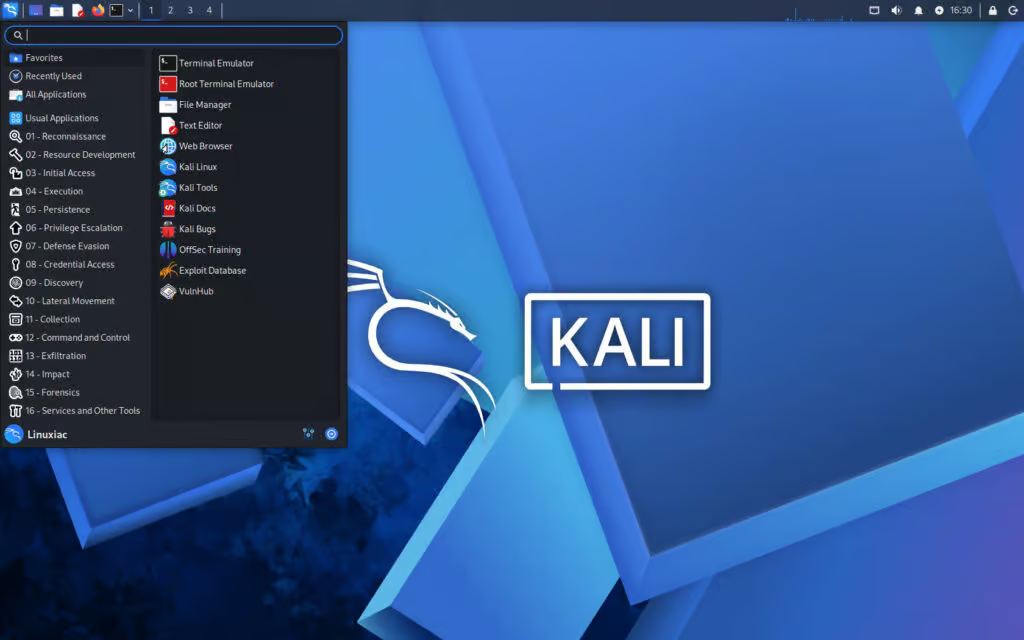
This release brings eight new tools into the repositories, including AdaptixC2 for post-exploitation and adversarial emulation, Atomic-Operator for executing Atomic Red Team tests, Fluxion for security auditing and social engineering research, GEF for enhanced GDB debugging, MetasploitMCP as an MCP server for Metasploit, SSTImap for detecting server-side template injection vulnerabilities, WPProbe for WordPress plugin enumeration, and XSStrike for XSS scanning.
In addition, Kali Linux 2026.1 introduces 25 new packages, removes 9 outdated ones, and updates 183 existing packages. The kernel has been upgraded to version 6.18.
There is a known issue with the kali-tools-sdr metapackage, where several GNU Radio-based tools such as gr-air-modes and gqrx-sdr are not currently working as expected. Developers have indicated that this will be resolved in a future update.
Kali NetHunter also sees multiple improvements, including fixes for WPS scanning, HID permission handling, and navigation. Device-specific updates include a new Android 16 kernel for the Redmi Note 8 and enhancements for the Samsung Galaxy S10 series, allowing internal wireless firmware to be utilized by tools like Reaver, Bully, and Kismet.
Furthermore, wireless injection support has been extended to QCACLD 3.0 chipsets via a new patch, increasing compatibility with a wider range of Qualcomm-based devices.
Kali Linux 2026.1 is available as fresh installation images, while existing users can upgrade by refreshing their package sources and performing a full system upgrade using APT.
For more information, see the announcement.
add a comment


Playwright Framework: A Modern Solution for Web Testing and Automation
In today’s fast-paced development world, ensuring web applications work flawlessly across browsers is critical. This is where the Playwright framework...

Oracle Releases Unbreakable Enterprise Kernel 8.2 Based on Linux 6.12 LTS
Oracle has introduced Unbreakable Enterprise Kernel (UEK) 8.2, a high-performance kernel for Oracle Linux built on the Linux 6.12 LTS...
GNOME Usage: The Lightweight System Monitor
Introduction Most Linux sysadmins and power users will immediately reach for htop, top, or a full-featured GUI tool like GNOME...
apt vs apt-get: What’s the Real Difference and Which Should You Use on Linux?
Introduction If you have spent any meaningful time on a Debian-based Linux system — whether that is Ubuntu, Linux Mint,...