




18views

Arch Linux’s guided installer has received a major overhaul in Archinstall 4.0, introducing a revamped terminal interface along with substantial under-the-hood improvements.
The most notable update is the shift away from the old curses-based system to a new text-based interface built on the Textual framework, offering more modern rendering and a smoother, more consistent user experience.
Beyond the interface redesign, Archinstall 4.0 brings several new features. Firewall setup is now built directly into the installer, letting users configure basic network security—including support for firewalld—during installation.
This version also revises bootloader management, with adjustments and rollbacks affecting GRUB, as well as enhancements to EFI stub behavior. Support for GRUB UKI menu entries has been introduced to better align with modern Linux boot practices.
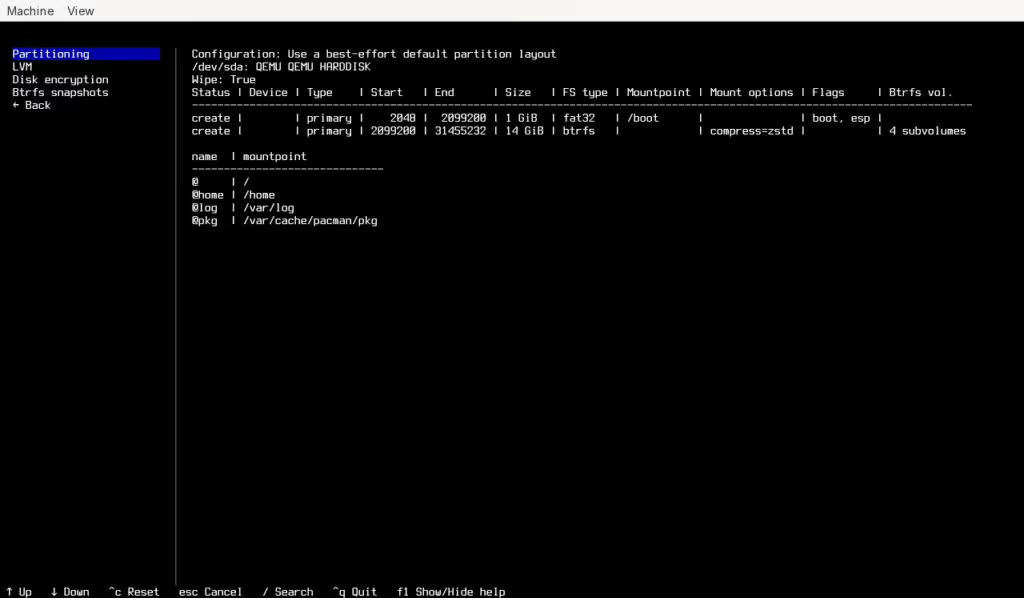
Storage and filesystem handling have been refined with targeted fixes. Issues with mounting Btrfs partitions lacking defined mount points have been addressed, and NTFS is no longer supported as a root filesystem. Additional improvements cover LUKS handling, disk tools, and partitioning processes.
Networking and system configuration have also been updated. Fixes for iwd-based installations, improved mirror management, and a restructured configuration system using dependency injection help streamline operations and reduce complexity.
According to the developers, much of the work focuses on internal refactoring. The codebase has been reorganized, redundant components removed, and type handling modernized using updated Python features. Key modules—such as those for disk management, authentication, and application handling—have been redesigned to minimize circular dependencies and ensure more consistent behavior.
Localization support has expanded as well, adding new languages like Galician and Nepali, while improving existing translations including Japanese, Italian, Turkish, and Ukrainian.
Other enhancements include more accurate installation timing, tweaks to package management, updates to default desktop options like the Plasma login manager, and a range of fixes across menus and workflows.
For more information, see the changelog.
add a comment

Rspamd 4.0 Spam Filtering System Released With checkv3 Protocol
Rspamd 4.0, the latest release of the popular open-source spam filtering system for mail servers and gateways, brings major architectural...

Incus 6.23 Container & Virtual Machine Manager Released
The Incus project has rolled out version 6.23, marking the final update in the 6.x series before the anticipated 7.0...


KaOS 2026.03 Released With Major Move Away From systemd Components
The KaOS project has rolled out its March 2026 ISO, introducing one of the most extensive internal transformations the distribution...


8 Ubuntu Terminal Tools You Must Master in 2026
Introduction1. micro — The Terminal Editor With Zero Learning Curve2. Neovim — IDE-Level Terminal Editing When You Are Ready3. tmux...
