Physical Address
304 North Cardinal St.
Dorchester Center, MA 02124
Physical Address
304 North Cardinal St.
Dorchester Center, MA 02124

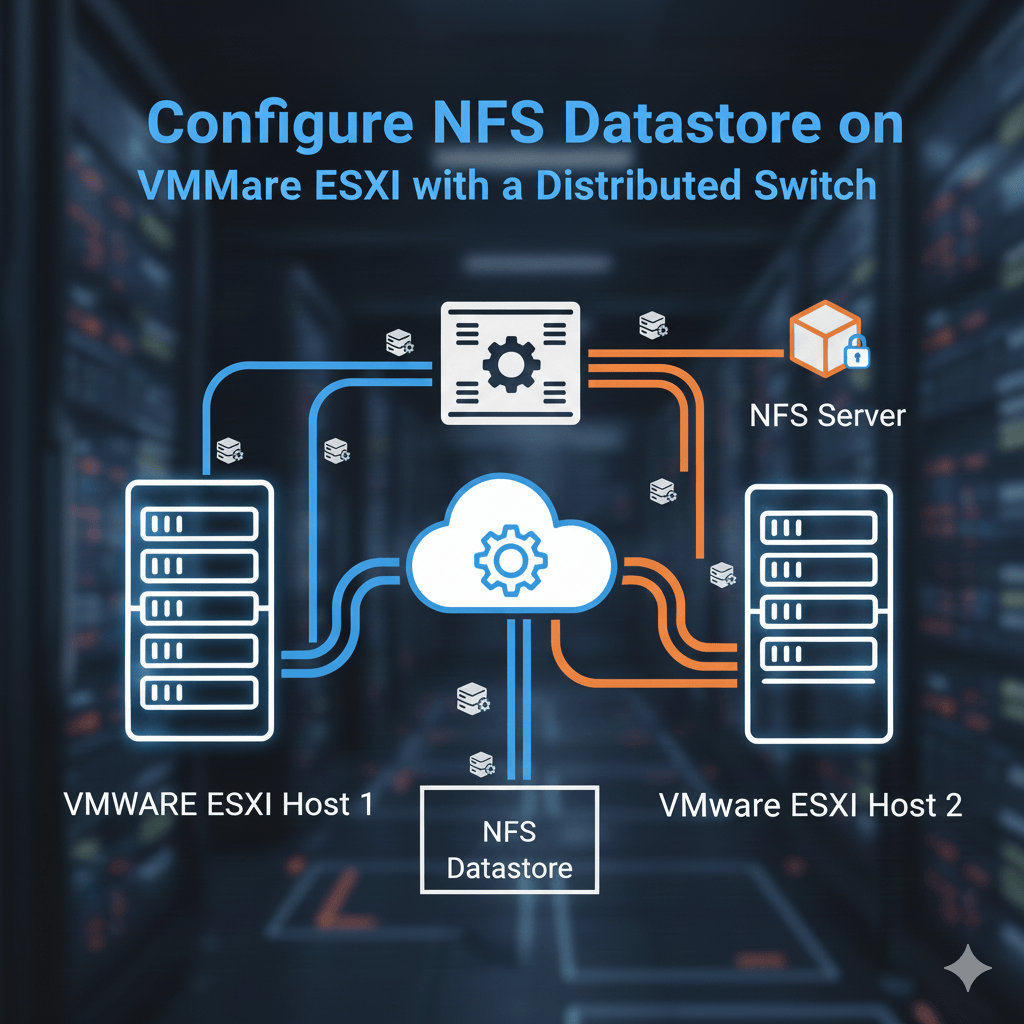
In VMware environments, using NFS storage is one of the simplest ways to provide shared storage for ESXi hosts. When combined with a VMware Distributed Switch (VDS), it offers better network management, traffic isolation, and scalability across multiple ESXi hosts.
This tutorial will guide you through configuring Windows Server 2022 as an NFS server, creating a dedicated VMkernel port on an ESXi host (192.168.91.128), and connecting it to your NFS datastore via VMware Distributed Switch (VDS) managed by vCenter (192.168.91.130).
Before you begin, ensure the following:
| Component | IP Address | Notes |
|---|---|---|
| vCenter Server | 192.168.91.130 | Already installed, managing ESXi hosts |
| ESXi Host | 192.168.91.128 | Added to vCenter |
| Windows Server 2022 | 192.168.91.129 | Will act as NFS server |
| Network | Same subnet 192.168.91.0/24 | Ensure connectivity between ESXi and NFS |
Open Server Manager
Click Manage → Add Roles and Features. Select Role-based or feature-based installation
Select your server (192.168.91.129)
Expand File and Storage Services → File and iSCSI Services. Check Server for NFS. Click Next → Install and Restart if prompted
Explanation:
The Server for NFS allows ESXi hosts to connect to shared folders over the network using the NFS protocol.
I have created a detail setup on how to configure NFS datastore.
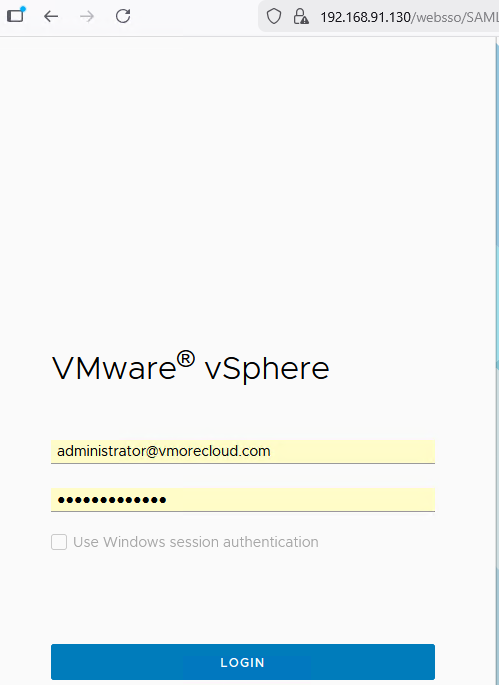
Open Web broswer and log in to vCenter (192.168.91.130). Type username and password and hit login button.
Click here to download VMware vCenter 8.0
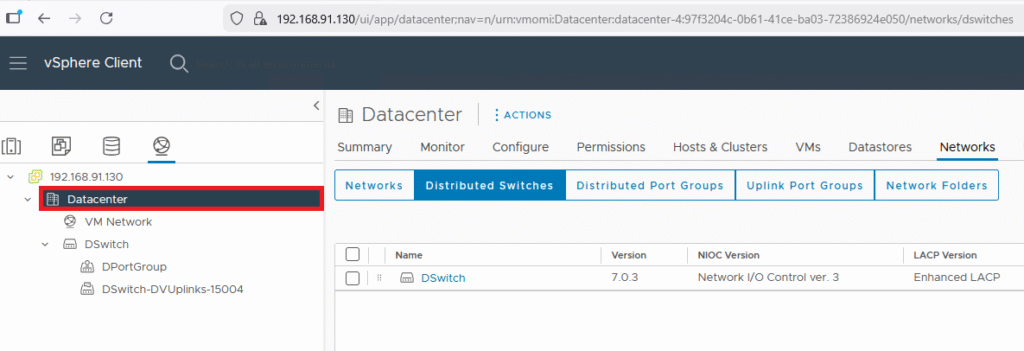
Go to Datacenter → Create a Distributed Switch
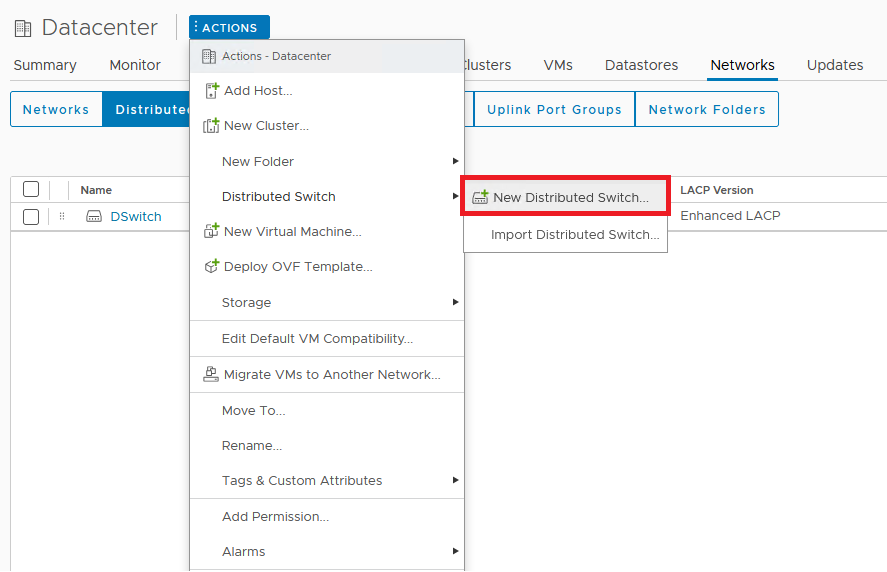
Click on Action and select, and select Distributed Switch. click on New Distributed Switch.
Name: VDS-Storage
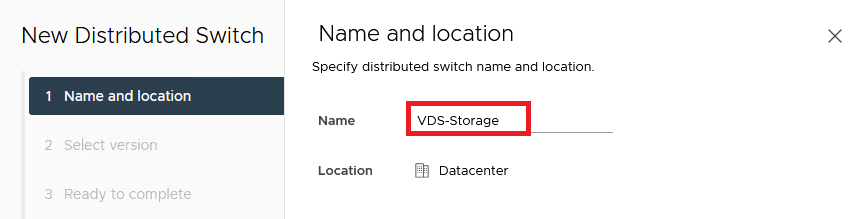
Version: Use latest supported by your ESXi host Add ESXi host (192.168.91.128) to the VDS.
Assign uplinks (physical NICs) for redundancy (e.g., vmnic0, vmnic1), and Click Finish
Explanation: A Distributed Switch allows VMkernel and VM traffic to be centrally managed and consistent across multiple hosts.
In vCenter → Networking → VDS-Storage → VMkernel Adapters → Add Host Networking
Select VMkernel Network Adapter. Choose VDS-Storage as the switch
Configure:
| Setting | Example |
|---|---|
| Network Label | NFS-Storage |
| VLAN ID | 0 (or your storage VLAN) |
| IP Address | 192.168.91.131 |
| Subnet Mask | 255.255.255.0 |
| Gateway | Leave blank |
Leave services unchecked (NFS does not require enabling vMotion, Management, etc.). Assign uplinks to physical NICs (vmnic0 and vmnic1 for redundancy). Finish configuration
SSH into ESXi host (192.168.91.128) and run:
vmkping 192.168.91.129
Successful ping confirms connectivity between VMkernel NIC and NFS server. Ready to mount NFS datastore.
| Field | Value |
|---|---|
| Name | Win2022-NFS |
| NFS Server | 192.168.91.129 |
| Share Path | /NFS-ESXi |
| NFS Version | NFS 3 |
Click Next → Finish and Verify datastore appears in vCenter → Storage
Using a Windows Server 2022 NFS share with a VMware Distributed Switch ensures:
This setup is ideal for home labs, SMBs, and enterprise labs using vSphere and vCenter.
By creating a dedicated VMkernel port for NFS on a Distributed Switch, you ensure reliability, scalability, and best practices compliance for VMware storage.
Using the same VDS guarantees consistent VMkernel, VLAN, and NIC settings across all hosts. This prevents storage disconnections, improves vMotion, and ensures stable high availability.
Yes. vSphere supports live migration of VMkernel adapters from a standard switch to a VDS as long as the host maintains IP connectivity and at least one NIC stays active.
VMware recommends using two or more physical NICs dedicated to storage traffic, configured with NIC teaming and optionally LACP for redundancy and throughput.
Yes, but not recommended. Storage should have dedicated uplinks to prevent congestion and improve performance.
A Distributed Switch eliminates configuration drift and ensures every host uses identical settings, which is crucial for stable storage and vMotion networking.
vmkping IP Address



There is definately a lot to find out about this subject. I like all the points you made