Physical Address
304 North Cardinal St.
Dorchester Center, MA 02124
Physical Address
304 North Cardinal St.
Dorchester Center, MA 02124

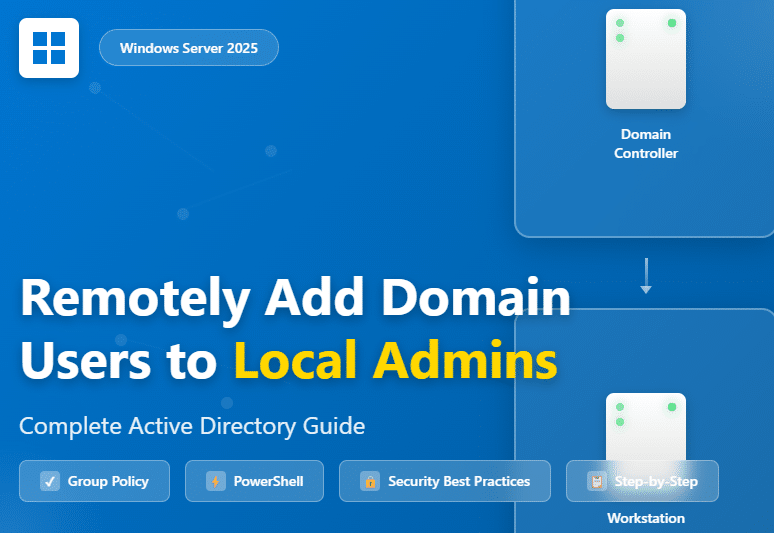
Managing user permissions across multiple workstations in an Active Directory environment can be challenging, especially when you need to grant local administrator rights to specific users without physically accessing each machine. If you’re running Windows Server 2025 and need to remotely add domain users to the local Administrators group, you’re in the right place.
This comprehensive guide walks you through multiple proven methods to accomplish this task efficiently, whether you’re managing a handful of computers or an entire enterprise network. I’ve personally implemented these techniques across various organizational environments, and I’ll share the practical insights you need to make informed decisions.
Before diving into the how-to, let’s understand the practical scenarios where this becomes necessary:
Common Real-World Scenarios:
However, granting local administrator privileges requires careful consideration. Microsoft’s security best practices recommend limiting administrator accounts to minimize potential security risks. You should only grant these permissions when absolutely necessary and use security groups rather than individual user accounts for easier management.
When you join a computer to an Active Directory domain, two groups are automatically configured:
For security reasons, daily administrative tasks should not be performed under Domain Admin privileges. Instead, create specialized groups like HelpDesk Admins or Workstation Admins with carefully scoped permissions. This principle of least privilege significantly reduces your attack surface.
Group Policy Preferences (GPP) offers the most scalable and maintainable approach for managing local administrator permissions across your domain. This method is ideal when you need to manage permissions for multiple computers or entire organizational units.
Step 1: Create a Security Group
First, create a dedicated security group in Active Directory. This makes permission management much easier than adding individual users.
Open PowerShell on your domain controller and run:
powershell
New-ADGroup -Name "WorkstationAdmins" -Path "OU=Groups,OU=IT,DC=yourdomain,DC=com" -GroupScope Global -PassThruAdd users to this group:
powershell
Add-ADGroupMember -Identity "WorkstationAdmins" -Members jsmith, mjohnson, kdavisStep 2: Create and Configure the GPO
Step 3: Configure the Local Administrators Group
Navigate through the console to:
Computer Configuration → Preferences → Control Panel Settings → Local Users and GroupsImportant Note: Even if the Administrators group has been renamed on target computers, selecting “Administrators (built-in)” ensures the policy applies correctly because it references the group’s Security Identifier (SID: S-1-5-32-544), which never changes.
Step 4: Add Your Security Group
Critical Security Configuration:
If you want complete control over the Administrators group membership (removing all existing members except those you specify):
To re-add Domain Admins:
If you want to preserve existing members and simply add your new group, leave both delete options unchecked.
Step 5: Link the GPO to Target OUs
Step 6: Verify the Policy Application
On a target workstation, force a Group Policy update:
powershell
gpupdate /forceThen verify the local Administrators group membership:
powershell
net localgroup AdministratorsOr using PowerShell:
powershell
Get-LocalGroupMember -Group "Administrators"For granular control, you can apply this GPO only to specific computers or conditions:
This allows you to apply the policy selectively without creating multiple GPOs.
PowerShell remoting provides instant results without waiting for Group Policy replication. This method is perfect for one-time additions or urgent access requirements.
powershell
# Define the target computer and domain user
$computerName = "WORKSTATION01"
$domainUser = "YOURDOMAIN\username"

# Add the user to the local Administrators group
Invoke-Command -ComputerName $computerName -ScriptBlock {
    param($user)
    Add-LocalGroupMember -Group "Administrators" -Member $user
} -ArgumentList $domainUser

Write-Host "Successfully added $domainUser to Administrators group on $computerName"powershell
# Define an array of target computers
$computers = @("PC001", "PC002", "PC003", "PC004")
$domainGroup = "YOURDOMAIN\WorkstationAdmins"

# Loop through each computer and add the group
foreach ($computer in $computers) {
    try {
        Invoke-Command -ComputerName $computer -ScriptBlock {
            param($group)
            Add-LocalGroupMember -Group "Administrators" -Member $group
        } -ArgumentList $domainGroup

        Write-Host "✓ Successfully added $domainGroup to $computer" -ForegroundColor Green
    }
    catch {
        Write-Warning "✗ Failed to add $domainGroup to $computer - Error: $_"
    }
}powershell
Invoke-Command -ComputerName "WORKSTATION01" -ScriptBlock {
    Get-LocalGroupMember -Group "Administrators"
}This method works well when you need to quickly grant permissions to a single user on a specific computer and you have physical or remote desktop access.
Win + Rcompmgmt.msc and press EnterDOMAIN\usernameFirewall Requirement: For this method to work, you must enable the Group Policy setting “Allow inbound remote administration exception” under:
Computer Configuration → Administrative Templates → Network → Network Connections → Windows Firewall → Domain ProfilePsExec is part of Microsoft’s Sysinternals suite and works even in environments where PowerShell remoting isn’t configured.
C:\Tools\PsToolscmd
psexec \\COMPUTERNAME net localgroup Administrators "DOMAIN\username" /addExample:
cmd
psexec \\WORKSTATION01 net localgroup Administrators "CONTOSO\jsmith" /addThe advantage of PsExec is that it only requires the same firewall exceptions as Computer Management (file and printer sharing).
This method uses the ADSI type adapter for direct manipulation of the local group:
powershell
$computerName = "WORKSTATION01"
$domainUser = "YOURDOMAIN\username"

# Create reference to the local Administrators group
$group = [ADSI]"WinNT://$computerName/Administrators,group"

# Create reference to the domain user
$user = [ADSI]"WinNT://YOURDOMAIN/$username,user"

# Add the user to the group
$group.Add($user.Path)

Write-Host "Successfully added $domainUser to Administrators group on $computerName"
Firewall Note: This method requires the “Allow inbound file and printer sharing exception” policy to be enabled.
Windows Server 2025 introduces several enhancements that affect Active Directory management:
Windows Server 2025 includes improved security baselines and group policy templates. When implementing local administrator policies, ensure you’ve updated your administrative templates:
\\yourdomain.com\SYSVOL\yourdomain.com\Policies\PolicyDefinitionsServer 2025 offers faster group policy processing and better targeting options, making the GPP method even more efficient than previous versions.
All PowerShell methods in this guide use the modern *-LocalGroupMember cmdlets, which are fully supported and recommended in Windows Server 2025 environments.
Always add security groups to the local Administrators group rather than individual user accounts. This approach offers several advantages:
Microsoft recommends creating separate administrative groups with specific scopes:
Never perform daily administrative tasks under Domain Admin accounts. This limits the potential damage from compromised credentials.
For enhanced security, consider implementing LAPS instead of granting widespread local admin rights:
LAPS is particularly useful for break-glass scenarios where users need temporary administrative access.
Implement auditing to track changes to local Administrators groups:
powershell
# Enable auditing in Group Policy
# Navigate to: Computer Configuration → Policies → Windows Settings →
# Security Settings → Advanced Audit Policy Configuration →
# Audit Policies → Account Management → Audit Security Group Management
Configure alerts for unauthorized changes to maintain security oversight.
Maintain clear documentation of:
This documentation is crucial for security audits and compliance requirements.
Symptoms: Group policy doesn’t add the user/group to local Administrators
Solutions:
gpresult /h report.html on the target computer to see which policies are applyingSymptoms: PowerShell commands fail with “Access Denied”
Solutions:
Symptoms: Cannot connect to remote computer via compmgmt.msc
Solutions:
ping or Test-ConnectionSymptoms: Invoke-Command fails to connect
Solutions:
powershell
Enable-PSRemoting -Forcepowershell
Set-Item WSMan:\localhost\Client\TrustedHosts -Value "COMPUTERNAME" -Forcepowershell
Get-Service WinRMpowershell
Test-WSMan -ComputerName WORKSTATION01Symptoms: Domain Admins lose access to computers after applying GPO
Solution: This happens when you select “Delete all member groups” without re-adding Domain Admins. Edit your GPO and explicitly add Domain Admins back to the Administrators group. The GPO should contain both your custom group and Domain Admins.
Managing local administrator permissions in Active Directory doesn’t have to be complicated. The Group Policy Preferences method offers the best balance of scalability, maintainability, and security for most organizations running Windows Server 2025. For immediate needs or smaller environments, PowerShell remoting provides quick and reliable results.

We have detected that you are using extensions to block ads. Please support us by disabling these ads blocker.