





14views

The Fedora Linux community has introduced Fedora 44 Beta, launching the testing phase before the final version expected around mid-April. This preview build runs on Linux Kernel version 6.19, bringing a range of updates across the installer, desktops, and development tools.
One notable improvement involves the Anaconda Installer. Instead of automatically creating profiles for every detected network interface, the installer now generates profiles only for devices actively configured during setup. This change simplifies network configuration and reduces unnecessary entries.
Users of Fedora’s KDE editions will find KDE Plasma version 6.6, along with a new Plasma Setup utility designed to handle post-installation configuration tasks. Because of this tool, several setup steps have been removed from the installer itself. Fedora KDE also adopts the Plasma Login Manager as its default display manager, replacing the older SDDM setup.
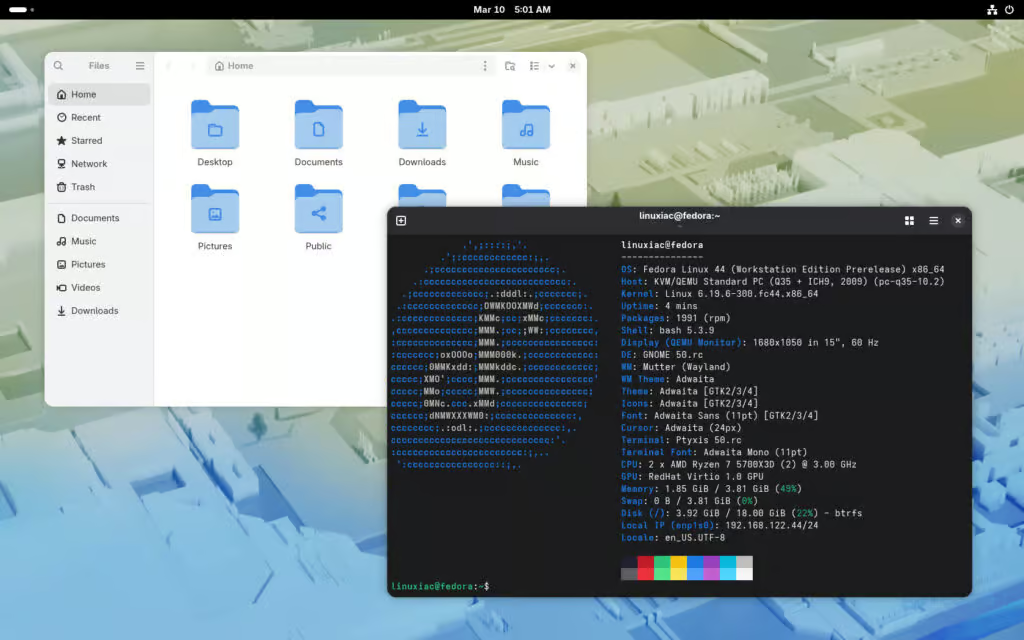
The Workstation edition ships with GNOME 50 Release Candidate, with the finalized GNOME 50 expected to appear in the official Fedora 44 release.
Some Fedora variants also see notable changes. Fedora Games Lab now runs on KDE Plasma rather than Xfce, offering a more modern Wayland-based environment for gaming and development. Meanwhile, the Budgie Desktop edition upgrades to Budgie 10.10 and begins its transition from X11 to Wayland to support future improvements.
The LiveCD experience receives several enhancements as well. Fedora 44 Beta introduces automatic device tree detection, enabling aarch64 live images to operate on Windows-on-ARM laptops. Updated scripts and automatic persistent overlays also make USB-based installations more flexible.
On the development side, the GNU toolchain—covering GCC, glibc, binutils, and GDB—has been refreshed to recent upstream versions. Fedora’s repositories now also include the Nix package manager as an optional tool for developers.
Fedora continues advancing its reproducible build initiative, reporting that about 90% of packages can already be reproduced, with a goal of reaching around 99% by the time Fedora 44 is finalized.
Other updates include newer versions of several key components such as Golang 1.26, MariaDB 11.8 as the default database, IBus 1.5.34, Django 6.x, Helm 4, Ansible 13, TagLib 2, and TeX Live 2025.
At the same time, Fedora is cleaning up older technologies. The project will stop building QEMU for 32-bit host systems, remove FUSE 2 libraries from Atomic desktops, and eliminate support for outdated pkla polkit rules.
The Fedora 44 Beta release is available across several editions, including Workstation, KDE Plasma Desktop, Server, IoT, and Cloud. Installation images can be downloaded from Fedora’s official mirrors, while the Fedora CoreOS “next” stream is expected to adopt the Fedora 44 base shortly afterward.
add a comment


KDE Plasma 6.5.6 Released as Final Bugfix Update for the 6.5 Series
The KDE Plasma team has published Plasma 6.5.6, the last maintenance update in the 6.5 series. This release effectively closes...

FRANK OS 1.0 Launches With a Retro Windows 95-Like Desktop
Blending retro inspiration with embedded development, a new open-source project named FRANK OS has introduced an interesting idea: running a...

CachyOS March 2026 Release Brings Animated Installer Previews
About six weeks after its previous January refresh, the performance-focused CachyOS distribution—built on Arch Linux—has rolled out its second update...

OpenWrt 25.12 Released with APK Package Manager Replacing opkg
The OpenWrt project has introduced OpenWrt 25.12, marking the first stable release in the new 25.12 series of its open-source...
