


25views
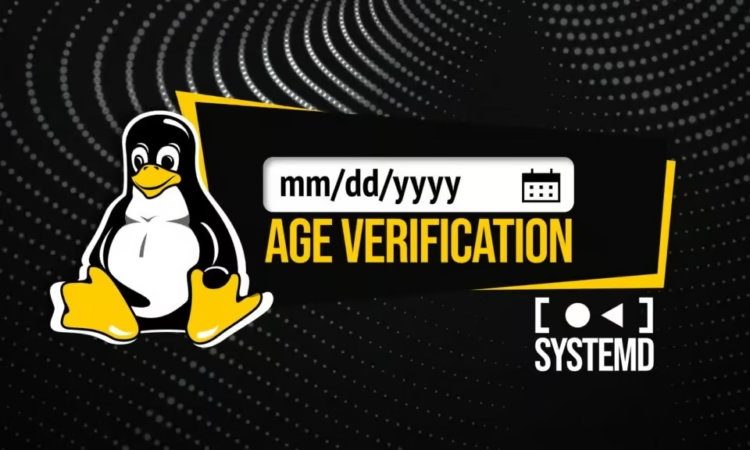
Recent discussions around age-verification regulations are starting to leave a mark on how the Linux desktop ecosystem evolves. As part of this shift, systemd has introduced a new birthDate field within its user record format—an early move toward incorporating standardized age-related data into the Linux desktop stack.
This change, added through a recent pull request, expands the systemd userdb JSON schema to store a user’s complete date of birth. The idea is to establish a reliable, system-level reference point that other components can use when age-related information is required. This field is not user-editable and must be configured by an administrator, typically via the homectl utility.
It’s worth noting that this feature does not directly implement any age verification or restriction mechanisms. Instead, it lays the groundwork for other services to build upon. At the same time, developers working on xdg-desktop-portal are introducing new APIs designed to let sandboxed applications determine whether certain content should be accessible based on the user’s age.
This design follows the familiar portal-based model used in Flatpak environments, where applications are restricted from directly accessing sensitive system data. Instead, they must request information through controlled interfaces. In this case, portals are expected to return only minimal responses—such as an age category or a simple allow/deny result—rather than exposing the full birth date.
Within this architecture, systemd functions purely as a backend data provider. By maintaining a consistent birth date at the system level, it allows higher-level services—like portals or account management tools—to make age-based decisions without requiring individual applications to handle such logic themselves.
The motivation behind this development is closely tied to evolving regulatory requirements. The associated systemd changes reference laws such as California AB-1043, Colorado SB26-051, and Brazil’s Lei 15.211/2025, all of which introduce stricter expectations around age verification, parental controls, and limiting minors’ access to certain online content.
Unsurprisingly, the addition has sparked debate within the developer community. Some argue that storing a full date of birth introduces unnecessary privacy risks and that broader age categories would be sufficient. Others counter that keeping the original data at the system level provides greater flexibility, while access can still be tightly controlled by higher-level components like portals.
From a technical standpoint, the separation between data storage and data exposure is crucial. While systemd retains the complete birth date, applications only interact with filtered responses provided by portal APIs. These portals effectively act as intermediaries, ensuring that sandboxed applications cannot directly access sensitive user information.
For distributions that do not use systemd—such as Void, Alpine, or Devuan—this change presents additional challenges. Without systemd’s userdb and the new birthDate field, they may need to implement alternative solutions, such as extending AccountsService or enhancing portal APIs to provide similar functionality, which will likely require extra development effort.
In summary, the introduction of a birthDate field does not immediately change the day-to-day experience for Linux users. However, it clearly reflects a broader trend toward integrating age-aware capabilities into desktop environments. Given the direction of global regulations, this shift appears increasingly unavoidable.
add a comment

Systemd 260 Drops SysV Init Support in Major Cleanup Update
The release of systemd 260 marks one of the most significant updates in recent versions, introducing sweeping changes that modernize...
Bottles 63.0 Introduces Proxy Support and Resolves Installation Issues
Bottles, an open-source tool built on Wine that lets users run Windows applications and games on Linux with a user-friendly...

DietPi 10.2 Released with Immich Support and New Software Options
DietPi, a lightweight and performance-optimized Linux distribution based on Debian, has rolled out version 10.2, marking the first update in...

Wayland 1.25 Released With Color Management Now Fully Documented
Following the 1.25 release candidate earlier this month, version 1.25 is now stable for this core code around Wayland.This includes...