Physical Address
304 North Cardinal St.
Dorchester Center, MA 02124
Physical Address
304 North Cardinal St.
Dorchester Center, MA 02124

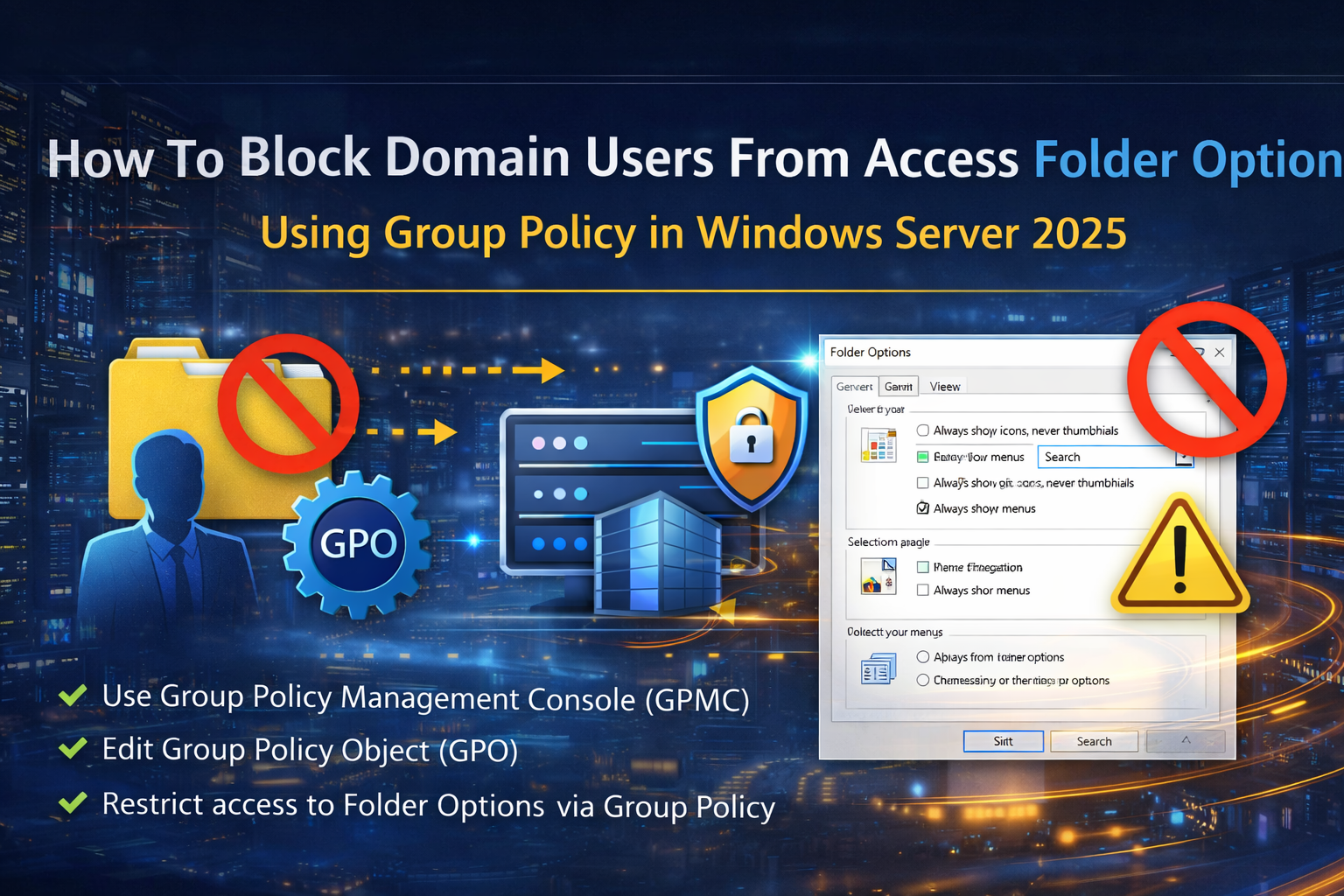
If you manage a Windows Server 2025 environment, you already know how quickly things can go sideways when users start tinkering with settings they shouldn’t touch. Folder Options in File Explorer is one of those deceptively simple menu items that lets users reveal hidden files, change file associations, and toggle system-critical display settings — changes that can expose sensitive data or break standardized desktop configurations across your entire domain. The good news? You don’t need third-party tools or complex scripts to handle this. Windows Server 2025 Group Policy gives you a built-in, centralized, and highly reliable mechanism to lock down Folder Options for all domain users — in just a few clicks from the Group Policy Management Console (GPMC). In this guide, we walk you through the entire process from start to finish.
Before jumping into the steps, let’s talk about why restricting Folder Options is a sound security and compliance practice:
Make sure you have the following before getting started:
Log in to your Windows Server 2025 domain controller or a management workstation with RSAT tools installed. Press Windows + R, type gpmc.msc, and hit Enter. The Group Policy Management Console will open.
In the left panel, expand your domain (e.g., vmorecloud.com) and navigate to the Organizational Unit (OU) where your domain users reside. Right-click the OU and select Create a GPO in this domain, and Link it here. Give your policy a clear, descriptive name such as Restrict-Folder-Options-Users. If you already have a policy for user restrictions, you can right-click and choose Edit on the existing GPO instead.
Inside the Group Policy Management Editor, follow this exact path:
User Configuration → Administrative Templates → Windows Components → File Explorer
This path falls under the User Configuration node — which is critical. Settings applied here follow the user account regardless of which machine they log into, making enforcement consistent across your entire domain.
In the right-hand panel under File Explorer policies, locate the setting named:
Removes the Folder Options menu item from the Tools menu
Double-click it to open the configuration window. You will see three options: Not Configured, Enabled, and Disabled. Select Enabled and click OK. That’s it — no scripts, no registry edits, no restarts required.
If you created a new GPO, ensure it is properly linked to the OU containing your domain users. In GPMC, you can verify this by checking the Linked Group Policy Objects tab on the target OU. The GPO should appear in the list with a status of Enabled.
Group Policy typically refreshes automatically every 90 minutes, but you can force an immediate update. On the domain controller, run:
gpupdate /force
On the client workstation (run as the affected user or via a remote session):
gpupdate /force
Now log in as a test domain user on any domain-joined workstation. Open File Explorer, click on the View menu (or the three-dot menu in Windows 11 Explorer), and confirm that the Folder Options entry is either missing or greyed out. If the policy is applied correctly, users will no longer be able to access it.
| Parameter | Detail |
| Policy Node | User Configuration → Administrative Templates → Windows Components → File Explorer |
| Policy Name | Removes the Folder Options menu item from the Tools menu |
| Setting Value | Enabled |
| Scope | Domain users in the linked OU |
| GPO Type | User-based (follows the user, not the machine) |
| Platform | Windows Server 2025 with Active Directory |
| Requires Restart? | No — gpupdate /force is sufficient |
| Admin Console | Group Policy Management Console (GPMC) |
| Verification Tool | gpresult /r or RSoP (Resultant Set of Policy) |
By default, GPOs apply to all Authenticated Users. To exclude IT admins from this restriction, open the GPO in GPMC, go to the Scope tab, remove Authenticated Users from Security Filtering, and add only the specific security group representing standard domain users. Then deny Apply Group Policy for your admin accounts.
Use gpresult /r on a client machine logged in as an affected user to confirm the policy is applying correctly. This shows you exactly which GPOs are active and being enforced for that session.
Always test new GPOs in a sandbox OU with a limited set of users before linking them to production OUs. This prevents disruption in live environments — a lesson every sysadmin learns once.
Maintain a GPO registry document that maps each policy to its intended purpose, linked OU, and creation date. This pays dividends during audits and when onboarding new team members.
The File Explorer node in Group Policy contains several complementary settings — such as hiding specific drives, preventing users from changing desktop wallpaper, and disabling the Run dialog. Consider building a comprehensive user lockdown policy that bundles related restrictions together.
If users can still access Folder Options after applying the GPO, work through this checklist:
Blocking Folder Options via Group Policy in Windows Server 2025 is one of those small configurations that delivers outsized security and operational value. It takes under five minutes to set up, requires zero scripting knowledge, and once deployed, it works silently in the background — consistently, across every machine your domain users log into.
Whether you’re hardening a corporate desktop environment, meeting compliance requirements, or simply reducing the number of “I accidentally changed something in File Explorer” support tickets, this Group Policy setting belongs in every domain administrator’s toolkit.
The beauty of Group Policy is its scalability — configure it once, and it follows every user across every workstation in your domain without any additional effort on your part. That’s exactly the kind of leverage that makes Windows Server 2025 such a powerful platform for managed IT environments.
If you found this guide useful, explore more Windows Server 2025 and Active Directory tutorials at vmorecloud.com — your go-to resource for home lab infrastructure, Group Policy deep dives, and real-world IT tutorials.

We have detected that you are using extensions to block ads. Please support us by disabling these ads blocker.