Physical Address
304 North Cardinal St.
Dorchester Center, MA 02124
Physical Address
304 North Cardinal St.
Dorchester Center, MA 02124

htop 3.5 has been released as the first major upstream update in about a year, bringing interface refinements, new monitoring meters, platform-specific enhancements for Linux, macOS, and BSD systems, along with build system improvements.
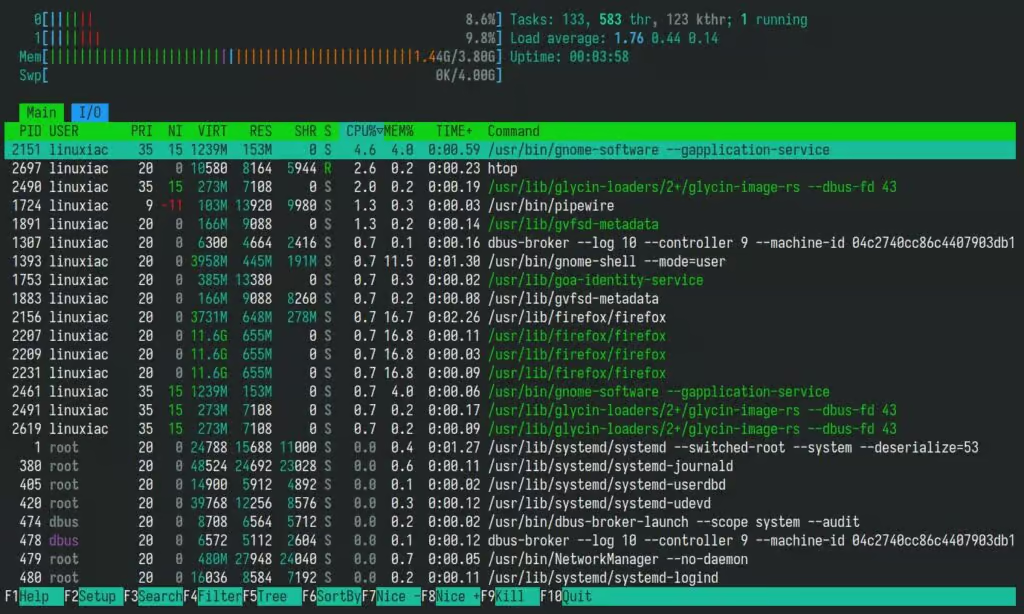
For those unfamiliar, htop is a cross-platform, terminal-based process viewer that serves as a more advanced alternative to top. It provides a real-time view of running processes, CPU and memory usage, and other system metrics, with user-friendly features like sorting, filtering, and interactive process management.
This release introduces a new line editor for Search, Filter, and screen renaming, along with digit-based editing for numeric options. It also adds support for the NO_COLOR environment variable and includes a new Nord-inspired color theme. For users who prefer a minimal interface, new options such as --no-meters and --no-function-bar are now available.
In terms of monitoring capabilities, htop 3.5 adds a backtrace screen powered by libunwind-ptrace, a SecondsUptimeMeter, a CPU SMT labeling option, and support for Tctl temperature readings. Graph and bar meter behavior has been refined, and disk I/O monitoring has been reworked. The DiskIOMeter is now a combined two-part display, complemented by two new meters: DiskIORateMeter and DiskIOTimeMeter.
On Linux systems, the update introduces support for the OpenRC init system and related metrics. It also improves CPU frequency detection from /proc/cpuinfo, correctly handles NUL-separated arguments, and excludes loopback and MD entries from /proc/diskstats.
Other platforms also benefit from updates. On macOS, GPU monitoring code has been added, along with improved OS version reporting, SysArchMeter enhancements, and restored process CPU time conversion. FreeBSD receives an updated internal priority reference, NetBSD improves process state handling, and OpenBSD fixes AC power reporting issues while updating ACPI-related documentation. Solaris now refreshes memory statistics with each update cycle.
Additionally, several under-the-hood improvements enhance performance and reliability. Startup latency has been reduced by removing the initial delay, boot performance is improved through caching of getpwuid results, and the application avoids writing the htoprc configuration file when it is not owned by the effective user. The release also includes updates to the build and packaging system, with new package definitions for distributions like openSUSE and SLES.
For more details, see the changelog.
As before, htop is distributed upstream as source code. Precompiled binaries are typically provided by Linux distributions and other operating systems through their package repositories.

We have detected that you are using extensions to block ads. Please support us by disabling these ads blocker.



