
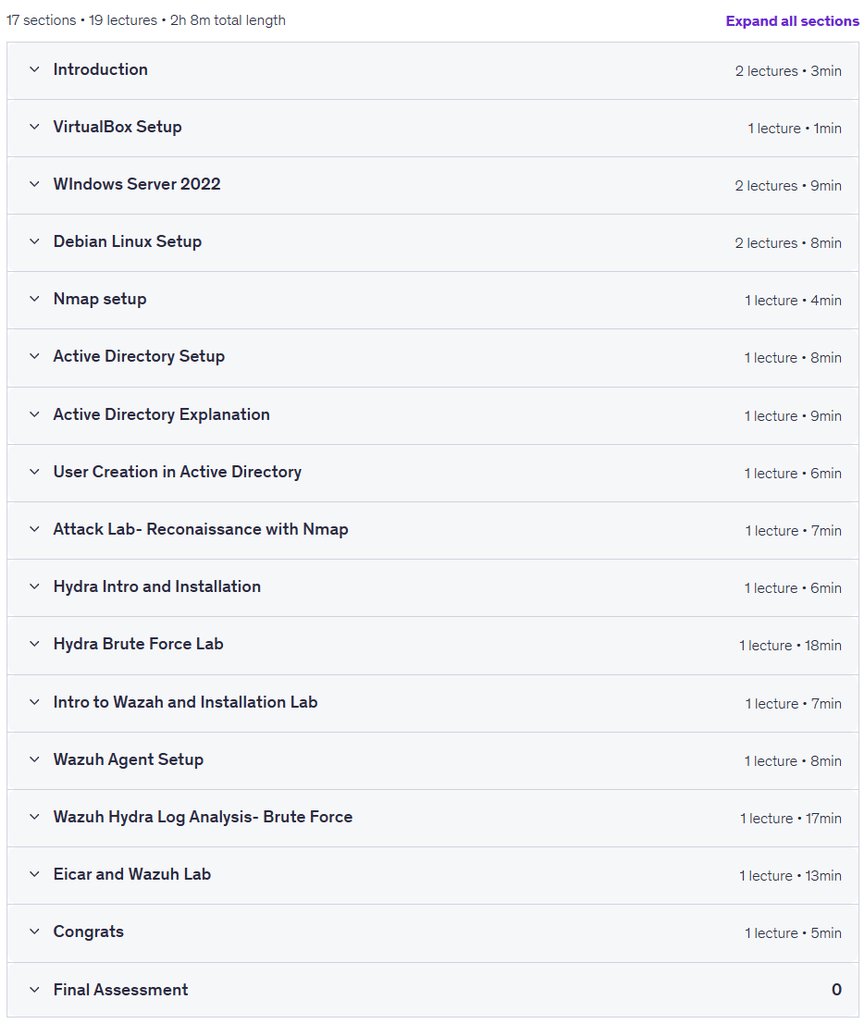
Cybersecurity Lab: Windows Server, Wazuh, Nmap, Linux & AD. This course will design and set up a comprehensive cybersecurity lab with Windows Server, Linux, and threat analysis tools. This training program is designed for beginners and enthusiasts who are looking for real, practical cybersecurity skills that go beyond dry theory, rote memorization of jargon, and complex technical jargon. In this course, participants will learn how to build a complete security lab from scratch using free tools. Step by step, they will configure a domain controller and add a Linux attack machine to learn how to scan the network, perform password attacks, log logs, detect threats, and alert in real-world environments. The course then moves on to tools that security analysts use every day. Learners will learn about Nmap for network and vulnerability discovery, Hydra for password-guessing attacks, Active Directory enumeration principles, Wazuh for logging and analyzing alerts, and ICAR files for simulating malware in a secure environment. The goal is for participants to understand not only how to run the tools, but also why they are important so they can confidently enter the workforce, build home labs, and prepare for valid certifications. Along the way, the power of AI for analysis is explored, while the importance of validating AI recommendations is emphasized.
What you will learn
- Building a replicable virtual lab using Windows Server 2022, Active Directory, Wazuh, and Kali Linux.
- Discover and map the lab network and Active Directory services using Nmap, along with performing LDAP enumeration and queries.
- Conducting controlled tests of brute force attacks using Hydra and analyzing the results.
- Receive, review, and analyze logs and reports using the Wazuh tool.
- Learn essential Linux command line commands for lab management and penetration testing including package management, file operations, and network commands.
- Familiarity with basic networking concepts, IP addressing, and TCP/IP protocols without the need for prior experience.
This course is suitable for people who:
- Cybersecurity students and enthusiasts: People who want to advance from beginner to intermediate level and experience practical-oriented training.
- Beginner System Administrators: Newbies who want to improve their server configuration and management skills.
- Professional certification candidates: Those preparing for security and networking exams and need lab practice.
- Penetration testing enthusiasts and defense teams: People who want to learn how to identify, investigate, and set up alerts for security information management and intrusion detection systems.
Rapidgator link
File size
846 MB