Physical Address
304 North Cardinal St.
Dorchester Center, MA 02124
Physical Address
304 North Cardinal St.
Dorchester Center, MA 02124
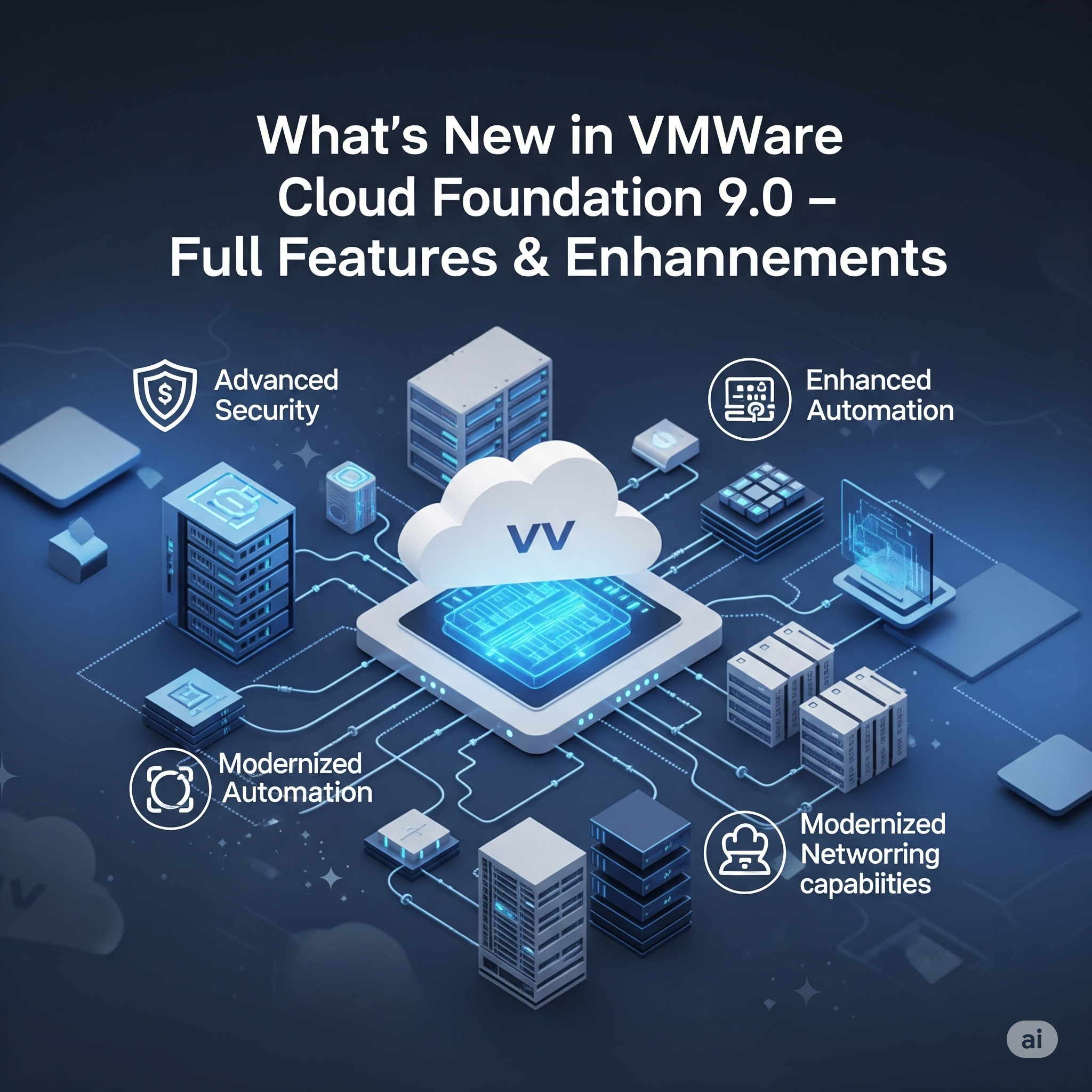
VMware Cloud Foundation (VCF) 9.0 is more than an update it’s a bold step toward the future of private cloud infrastructure. With this release, VMware (now under Broadcom) is making it easier than ever to manage hybrid cloud environments with greater automation, improved security, and a streamlined user experience.
Whether you’re an infrastructure admin, a platform engineer, or part of a security operations team, VCF 9.0 delivers solutions that solve real-world challenges with speed and simplicity.

VCF 9.0 transforms the private cloud into a unified, full-stack platform that combines the agility of public cloud with the performance and control of on-premises infrastructure. It’s built to support modern application delivery, secure workloads, and drive consistent operations whether you’re running at the core, edge, or in the cloud.
Modern infrastructure is all about being fast, scalable, and resilient. VCF 9.0 makes this a reality by helping IT teams:
Here’s how:
The new VCF Installer in VMware Cloud Foundation 9.0 simplifies Day-0 deployment by replacing the older Cloud Builder tool with a more streamlined, visual, and automation-friendly experience. It offers a GUI/API-driven workflow with embedded pre-checks, supports replicating deployments using downloadable JSON files, and can convert existing vSphere clusters (with or without NSX) into VCF management domains. This reduces setup time, minimizes human error, and accelerates the path to a fully operational private cloud.
It features:
This significantly reduces the setup time and human error, giving teams a head starts on infrastructure deployment.
From a single pane of glass, manage:
This ensures your infrastructure stays compliant, secure, and easy to manage no more jumping between tools.

Built-in Multi-Tenancy for Resource Efficiency in VMware Cloud Foundation 9.0 allows IT admins to create and manage multiple isolated organizations within a single VCF environment. Each organization can have its own resource allocations, quotas, and user access controls, all managed natively through the platform. This structure provides clear visibility into resource consumption and spending, helping teams optimize infrastructure usage, reduce waste, and ensure efficient scaling across different departments or projects.
This gives you deeper visibility into resource utilization and costs, helping to drive efficiency and eliminate over-provisioning.
Benefits:
NVMe Tiered Memory is a new feature introduced in VMware Cloud Foundation 9.0 that allows an ESXi host to use an NVMe device as a second layer of memory, working alongside traditional DRAM. This balances DRAM and NVMe smartly, boosting:
More performance at lower TCO it’s that simple.
Traditionally, virtual machines (VMs) only use DRAM (RAM) for memory. But DRAM is expensive and limited in capacity. With NVMe Tiered Memory, you can extend your available memory by adding a high-speed NVMe SSD—a much cheaper and larger alternative to DRAM.
In VMware vSAN ESA (Express Storage Architecture), Global Deduplication means that identical data blocks are detected and stored only once not just on a single disk, but across the entire vSAN cluster.
Benefits:
✅ Improved Storage Efficiency: Use less space to store more data.
✅ Lower Storage Costs: Save money on storage hardware.
✅ Simplified Scaling: Add more hosts without worrying about duplicate data ballooning storage usage.
✅ Performance Optimized: ESA is built for speed and can handle deduplication with minimal impact.
Application teams want a cloud-like experience on-prem. VCF 9.0 bridges that gap by helping you:
Here’s how:
Admins can now create Virtual Private Clouds (VPCs) directly in the vSphere UI no deep networking skills required. This brings public cloud-style self-service networking to developers while ensuring security and resource isolation.
Self-Service IaaS via Supervisor Services in VMware Cloud Foundation 9.0 empowers application teams to directly provision virtual machines, Kubernetes clusters, networks, volumes, and databases using an intuitive UI, CLI, or API completely bypassing traditional ticketing systems. This streamlines infrastructure access, enabling faster development cycles and reducing dependency on IT operations for routine tasks.
VCF Automation now enables app teams to provision:
All through a simple UI, CLI, or API—no more ticket queues. This accelerates dev/test cycles and boosts developer autonomy.
Using a drag-and-drop or YAML interface, engineers can define reusable IaaS blueprints with networking, K8s clusters, and custom resources.
It’s plug-and-play cloud automation that helps standardize and scale app delivery.
Security teams face growing challenges around compliance, uptime, and cyber threats. VCF 9.0 is built to help:
Apply critical patches without taking hosts or VMs offline. This slashes downtime, speeds up remediation, and helps maintain SLAs even during high-severity updates.
With default FIPS mode, VCF 9.0 meets U.S. government-grade security standards—ideal for regulated industries handling sensitive data.
You can now replicate vSAN ESA snapshots asynchronously across sites. This delivers:
Manage identity, audit trails, compliance, and infrastructure security from a single console. This enables faster response to threats and unified risk management.
You can now:
This not only strengthens security but maximizes your investment in VCF.
VMware Cloud Foundation 9.0 isn’t just keeping up with change its pushing the industry forward. Whether you’re modernizing your infrastructure, empowering developers, or securing mission-critical workloads, this release gives you the tools to do more, faster and with less stress.
If you’re ready to simplify operations, reduce costs, and improve agility, VCF 9.0 is your foundation for the future.

We have detected that you are using extensions to block ads. Please support us by disabling these ads blocker.





Great 👍.