Physical Address
304 North Cardinal St.
Dorchester Center, MA 02124
Physical Address
304 North Cardinal St.
Dorchester Center, MA 02124

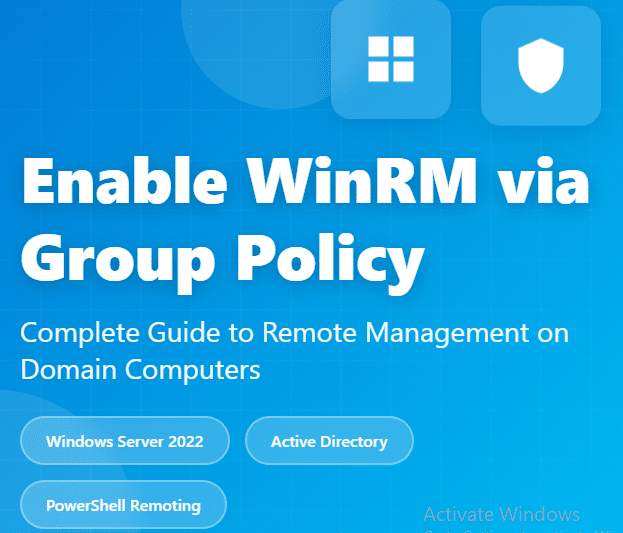
Windows Remote Management (WinRM) has become an indispensable tool for system administrators managing enterprise environments. Whether you’re running PowerShell remoting commands, deploying software updates, or performing routine maintenance across hundreds of computers, WinRM provides the foundation for efficient remote administration.
In this comprehensive guide, I’ll walk you through enabling WinRM on all domain-joined computers using Group Policy in Windows Server 2022 and 2025. This method ensures consistent configuration across your entire Active Directory domain without the need to manually configure individual machines.
Windows Remote Management (WinRM) is Microsoft’s implementation of the WS-Management protocol, a standard web services protocol for remote software and hardware management. Think of it as the backbone that powers remote administration in Windows environments.
When WinRM is enabled on your domain computers, you can:
The beauty of using Group Policy to enable WinRM is that you configure it once, and it automatically applies to all computers in your domain. No more logging into each machine individually or running scripts across hundreds of endpoints.
Before we dive into the configuration, it’s important to understand how WinRM works out of the box:
Windows Server (2012 and later): WinRM is enabled by default, making servers immediately available for remote management.
Windows Client OS (Windows 10/11): WinRM is disabled by default for security reasons. You need to manually enable it or use Group Policy.
Default Ports:
Authentication: By default, WinRM uses Kerberos authentication in domain environments, which provides secure, mutual authentication between client and server.
Before implementing WinRM via Group Policy, ensure you have:
Let’s walk through the complete process of creating and configuring a Group Policy Object to enable WinRM across your domain.
First, we’ll create a dedicated GPO for WinRM configuration. This keeps your policy organized and makes troubleshooting easier down the line.
Windows Key + R and type gpmc.msc to open the Group Policy Management Consolecontoso.com)"Enable WinRM for Domain Computers"Pro Tip: Create the GPO at an OU level rather than the domain level to maintain better control over which computers receive the policy. You can always link it to multiple OUs later if needed.
Now we’ll configure the actual WinRM service to enable remote management capabilities.
Computer Configuration → Policies → Administrative Templates → Windows Components → Windows Remote Management (WinRM) → WinRM Service* to allow connections from any IP address*Important Security Note: The IP filter fields specify which IP addresses the WinRM service binds to on the target computer, NOT which remote computers can connect. Using * means the service listens on all available network interfaces. For enhanced security in production environments, you can specify specific IP ranges like 192.168.1.* or individual IP addresses.
The WinRM service must be running for remote management to work. Let’s configure it to start automatically.
Computer Configuration → Preferences → Control Panel Settings → ServicesAutomatic (Delayed Start) (This prevents service conflicts during boot)... and search for WinRM or type Windows Remote Management (WS-Management)Start serviceWhy Delayed Start? Setting the service to Automatic (Delayed Start) prevents potential conflicts during system startup when multiple services are competing for resources. The service will start shortly after boot, typically within 2 minutes.
Even with WinRM enabled, Windows Firewall will block incoming connections by default. We need to create inbound rules to allow WinRM traffic.
Computer Configuration → Policies → Windows Settings → Security Settings → Windows Defender Firewall with Advanced Security → Windows Defender Firewall with Advanced SecuritySecurity Best Practice: Never enable WinRM on Public network profiles. Public networks are considered untrusted (like coffee shop WiFi). By limiting WinRM to Domain and Private profiles, you ensure remote management only works on trusted networks.
To ensure WinRM works properly, especially on workstations that might not automatically detect the domain profile, you can configure network location settings.
Computer Configuration → Policies → Windows Settings → Security Settings → Network List Manager PoliciesNot configured to PrivateThis ensures that even if a computer can’t identify the network, it will treat it as Private rather than Public, allowing WinRM to function.
Now that your GPO is fully configured, it’s time to apply it to your target computers.
gpupdate /forceNote: Group Policy normally refreshes every 90 minutes with a random offset of 0-30 minutes. Domain Controllers refresh every 5 minutes. Forcing an update ensures immediate application.
After applying the Group Policy, you should verify that WinRM is properly configured on your target computers.
On your administrative workstation, open PowerShell and run:
powershell
Test-WSMan -ComputerName "COMPUTERNAME"Replace COMPUTERNAME with the actual name of a target computer. If WinRM is configured correctly, you’ll see output showing the protocol version and product information.
Expected Output:
wsmid           : http://schemas.dmtf.org/wbem/wsman/identity/1/wsmanidentity.xsd
ProtocolVersion : http://schemas.dmtf.org/wbem/wsman/1/wsman.xsd
ProductVendor   : Microsoft Corporation
ProductVersion : OS: 10.0.19044 SP: 0.0 Stack: 3.0On the target computer:
On the target computer:
To verify the Group Policy applied correctly:
powershell
gpresult /H C:\GPReport.htmlOpen the HTML report and search for your WinRM GPO name to confirm it’s applied.
Once WinRM is verified, test actual remote connectivity:
powershell
Enter-PSSession -ComputerName "COMPUTERNAME" -Credential "DOMAIN\Administrator"If successful, your PowerShell prompt will change to show the remote computer name, indicating you’re now in a remote session.
powershell
Invoke-Command -ComputerName "COMPUTERNAME" -ScriptBlock { Get-ComputerInfo }This executes the Get-ComputerInfo cmdlet on the remote computer and returns the results.
powershell
$computers = "Computer1", "Computer2", "Computer3"
Invoke-Command -ComputerName $computers -ScriptBlock { $env:COMPUTERNAME }
This runs a command on multiple computers simultaneously, showcasing the power of WinRM.
For enhanced security, especially when managing computers over untrusted networks, configure WinRM to use HTTPS (port 5986).
Requirements:
Basic Setup:
powershell
$cert = New-SelfSignedCertificate -DnsName "server.contoso.com" -CertStoreLocation Cert:\LocalMachine\Mypowershell
New-Item -Path WSMan:\LocalHost\Listener -Transport HTTPS -Address * -CertificateThumbPrint $cert.Thumbprint -Forcepowershell
New-NetFirewallRule -DisplayName "WinRM HTTPS-In" -Direction Inbound -LocalPort 5986 -Protocol TCP -Action Allowpowershell
Enter-PSSession -ComputerName "server.contoso.com" -UseSSLFor tighter security, limit which IP addresses can establish WinRM connections.
Via Group Policy:
Instead of using * in the IPv4/IPv6 filter fields, specify allowed ranges:
192.168.1.100192.168.1.0-192.168.1.255192.168.1.*;10.0.0.*Via Local Configuration:
powershell
Set-Item WSMan:\localhost\Client\TrustedHosts -Value "192.168.1.100,192.168.1.101"By default, only Administrators can use WinRM. To grant access to non-admin users:
powershell
Add-LocalGroupMember -Group "Remote Management Users" -Member "DOMAIN\User"powershell
Set-PSSessionConfiguration -Name Microsoft.PowerShell -ShowSecurityDescriptorUIThis opens a dialog where you can grant specific users “Execute” permissions.
Track WinRM connections and commands for security auditing:
Computer Configuration → Administrative Templates → Windows Components → Windows PowerShellpowershell
Get-PSSessionUnderstanding how WinRM stacks up against other remote management tools helps you make informed decisions.
| Feature | WinRM | RDP |
|---|---|---|
| Purpose | Command execution, automation | Full desktop access |
| Resource Usage | Minimal | High (graphics, full session) |
| Simultaneous Users | Unlimited (per server capacity) | Limited (typically 2 on servers) |
| Use Case | Scripting, automation, bulk operations | Interactive troubleshooting, GUI apps |
Click here to read more about Windows Remote Management documentation
When to Use WinRM: Automated tasks, scripting, managing multiple computers simultaneously
When to Use RDP: GUI application access, user support, detailed troubleshooting
| Feature | WinRM | SSH |
|---|---|---|
| Platform | Windows-native | Cross-platform |
| Authentication | Kerberos, NTLM, Certificate | Key-based, password |
| Encryption | Built-in | Built-in |
| Windows Integration | Excellent | Good (requires OpenSSH) |
When to Use WinRM: Pure Windows environments, Active Directory integration
When to Use SSH: Mixed Windows/Linux environments, when standardization across platforms is priority
| Feature | WinRM | MMC |
|---|---|---|
| Automation | Excellent | Limited |
| Bulk Operations | Yes | No |
| Programming | Full PowerShell support | Manual GUI only |
| Learning Curve | Moderate | Easy |
When to Use WinRM: Automation, scripts, bulk operations
When to Use MMC: Quick manual tasks, visual preference, learning Windows administration
WinRM is the foundation for many modern Windows management tools:
Windows Admin Center relies on WinRM for remote management. With WinRM enabled via Group Policy, you can:
While Intune primarily uses cloud-based management, hybrid scenarios benefit from WinRM:
Configuration Manager uses WinRM for:
Azure Arc-enabled servers use WinRM for:
Enabling Windows Remote Management via Group Policy transforms how you manage Windows computers in a domain environment. What once required physical access or individual configuration now happens automatically and consistently across your entire infrastructure.
The benefits are clear:
By following this guide, you’ve learned not just how to enable WinRM, but how to do it securely, troubleshoot common issues, and leverage it for real-world administrative tasks. Whether you’re managing a small business network or an enterprise environment with thousands of endpoints, WinRM via Group Policy is an essential skill in your administrative toolkit.

We have detected that you are using extensions to block ads. Please support us by disabling these ads blocker.