

470views
MOS is a newly introduced open-source server operating system built specifically for homelabs and small self-hosting environments. Rather than focusing purely on network-attached storage (NAS), MOS positions itself as a general-purpose server platform managed entirely through a modern web-based interface.
Built on Devuan, the project is still in its early development phase. Its architecture follows a service-oriented design, where the web interface functions strictly as a client to the MOS API, while backend services handle all core system operations.
A Unified Approach to Homelab Management
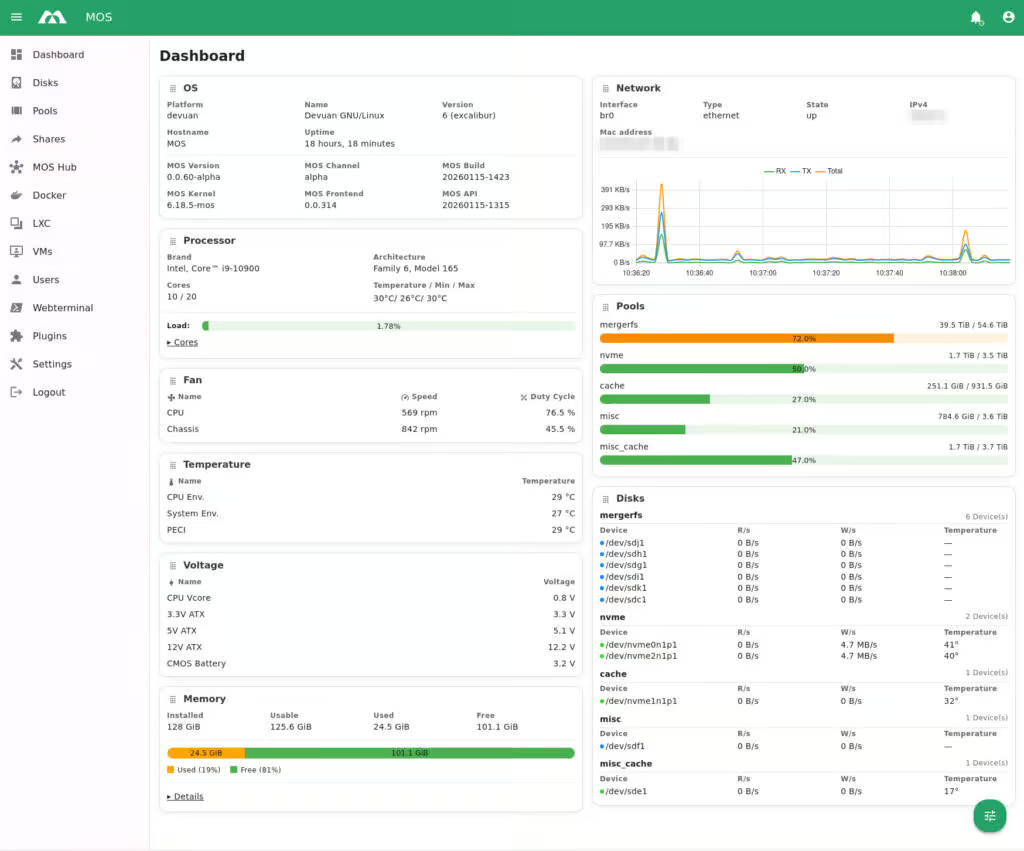
MOS brings together capabilities that are often distributed across multiple tools in a typical homelab setup. Through a centralized web interface, administrators can manage:
- System monitoring
- User accounts
- Storage pools and shared storage
- Containers (Docker & LXC)
- Virtual machines
Although MOS includes NAS functionality such as storage and file sharing, its primary objective is broader: to serve as a versatile server OS rather than a storage-first solution.
Core Focus Areas
The project emphasizes two main pillars:
- Server & Workload Management
- User and service administration
- Container management
- Virtual machine orchestration
- Host system administration
- Storage Management
- Storage pools
- Shared storage
- NAS capabilities when required
Unlike traditional NAS-focused operating systems—where storage is central and services are layered on top—MOS treats storage as important but not dominant.
Core & Optional Services
Core services include:
- System monitoring
- Storage and pool management
- User administration
- Container services
- Virtual machine support
- Web-based terminal access
Optional modules such as MOS Hub and MOS Notify can be enabled to extend functionality without increasing the base system footprint.
Security & Architecture
MOS uses token-based authentication for access control. For deployments beyond isolated lab environments, the project recommends:
- Enabling TLS with a reverse proxy
- Applying least-privilege access policies
- Keeping the system updated
- Regularly reviewing logs and notifications
Plugin-Based Extensibility
MOS supports plugins that can extend both the web interface and, where applicable, the API. Only registered and enabled plugins appear in the management interface, keeping the system clean and modular.
Installation Notes
MOS is not distributed as a traditional ISO image. Instead, users download an .xz archive, extract it, and mount the resulting raw image file as a USB device within a virtual machine.
For additional information, visit the project’s website, GitHub repository, or documentation.
add a comment

openSUSE Releases Agama 19 Installer with Many New Features and Improvements
The openSUSE project released the Agama 19 web-based installer for openSUSE Tumbleweed, Slowroll, and MicroOS operating systems, a major release...
Fedora Introduces Fedora Forge, Plans Full Pagure Migration by 2026
After nearly a year of planning and development, the Community Linux Engineering (CLE) team has officially introduced Fedora Forge, a new platform powered by Forgejo. This marks an important step forward for Fedora’s infrastructure. While Pagure has served the community reliably for many years, the project is now moving away from its in-house solution toward a more modern and scalable alternative. The complete transition is scheduled to take place during Flock to Fedora 2026, and project maintainers are strongly advised to migrate their repositories well in advance of the event....

Krita 5.3 and Krita 6.0 Released With New Text Engine and Wayland HDR Support
Following its beta release earlier this year, Krita has officially launched two parallel versions, 5.3 and 6.0, both derived from...

Mozilla Thunderbird 149 Brings Address Book Export and Multiple Bug Fixes
Mozilla has announced the release of Thunderbird 149, bringing new features and multiple fixes to its open-source desktop email client....