


Why Active Directory Password Policy Fails Modern Attacks (and What Admins Need Instead)

13views
According to Microsoft’s latest Digital Defense Report, 97% of identity-based attacks are password spray attacks. This highlights a key reality: most attackers aren’t relying on advanced cracking methods. Instead, they use a simple but highly effective tactic—trying a small set of common or previously compromised passwords across a large number of accounts.
In 2026, the biggest password risks go beyond weak or short credentials. The real threats are sprayed passwords, reused passwords, and credentials that may be secure today but appear in breach datasets tomorrow. Active Directory (AD) password policies are not outdated—they’re simply being pushed to address challenges they were never originally designed to handle.
Microsoft also emphasizes that reusing work or school passwords significantly increases risk. If one account is compromised, attackers can often pivot to others using the same credentials. Password spray attacks are especially effective because they rely on just a few weak passwords per account, staying under lockout thresholds and avoiding detection.
To counter this, NIST now recommends validating new passwords against blocklists of commonly used and previously breached passwords, helping organizations prevent the use of easily exploitable credentials.
What AD still does well
Group Policy and fine-grained password policies (FGPP) remain important because they establish the baseline security controls every Active Directory environment requires. The default domain password policy sets the minimum standard across the domain, while FGPP allows administrators to apply tailored password and lockout settings to specific groups—for example, enforcing stricter rules for privileged accounts and different policies for standard users.
These built-in controls still play a valuable role. By default, Active Directory can enforce:
- Minimum password length
- Password history and minimum/maximum age
- Account lockout threshold, duration, and reset timer
- Built-in complexity requirements
Microsoft’s Windows security baselines recommend starting with 10 failed sign-in attempts as the lockout threshold, along with 15 minutes for both lockout duration and reset counter. While this provides a strong foundation, it should be viewed as a baseline—not a complete security solution.
Where Group Policy and FGPP stop helping
- Modern NIST guidance has moved beyond the limits of traditional Active Directory password policies. It now requires that new passwords be validated against blocklists of commonly used, predictable, or compromised values, including those found in breach datasets and context-aware variations such as usernames. Native AD policies don’t provide this capability out of the box—they focus on enforcing length, age, history, lockout settings, and basic complexity rules.
2. Another key limitation is the lack of continuous validation. A password may fully comply with policy at the time it’s created but later become risky if it appears in breach data or is targeted in password spraying campaigns. Native GPO and FGPP do not continuously reassess passwords against evolving threat intelligence. This gap is one reason password expiration became a fallback strategy—but that approach is now outdated. Modern guidance recommends changing passwords only when there is evidence of compromise, rather than on a fixed schedule.
3. User behavior is another challenge. AD’s complexity requirements enforce character combinations and prevent obvious reuse of account names, but users tend to respond in predictable ways—creating passwords like Password1! that meet policy yet remain easy to guess. Microsoft has also noted that forced expiration encourages minor, predictable changes that attackers can anticipate.
This is why expiration policies are considered a blunt tool—they introduce friction without significantly improving security. What organizations need instead are smarter controls that can block weak or compromised passwords at creation time and continue monitoring them for exposure throughout their lifecycle.
A practical 2026 blueprint for AD password defense
Attackers have moved beyond the problems native policy was built to solve. Length, history, and lockout settings still set a baseline, but they do not tell you whether a password is already common, already exposed, or likely to succeed in a spray attack. That’s also why routine expiration has lost favor: it creates predictable user behavior and more help desk friction without solving the real risk.
A modern AD password strategy should do three things:
- Keep the native baseline: sensible length, lockout, and tiered policies (FGPP) for privileged vs. standard users.
- Block known-bad choices at set/change time: prevent compromised, common, and attacker-adjacent passwords from ever being set.
- Continuously re-check over time: identify passwords that become exposed later and remediate in a targeted way.
Put simply: keep AD’s baseline controls, stop relying on blanket rotation, and add a layer that can distinguish between a password that merely looks compliant and one that is actually safe. Native AD still can’t answer one critical question on its own: Is this password already known, guessable, or exposed in the real world?
The missing layer: enforcing “not already in attacker hands”
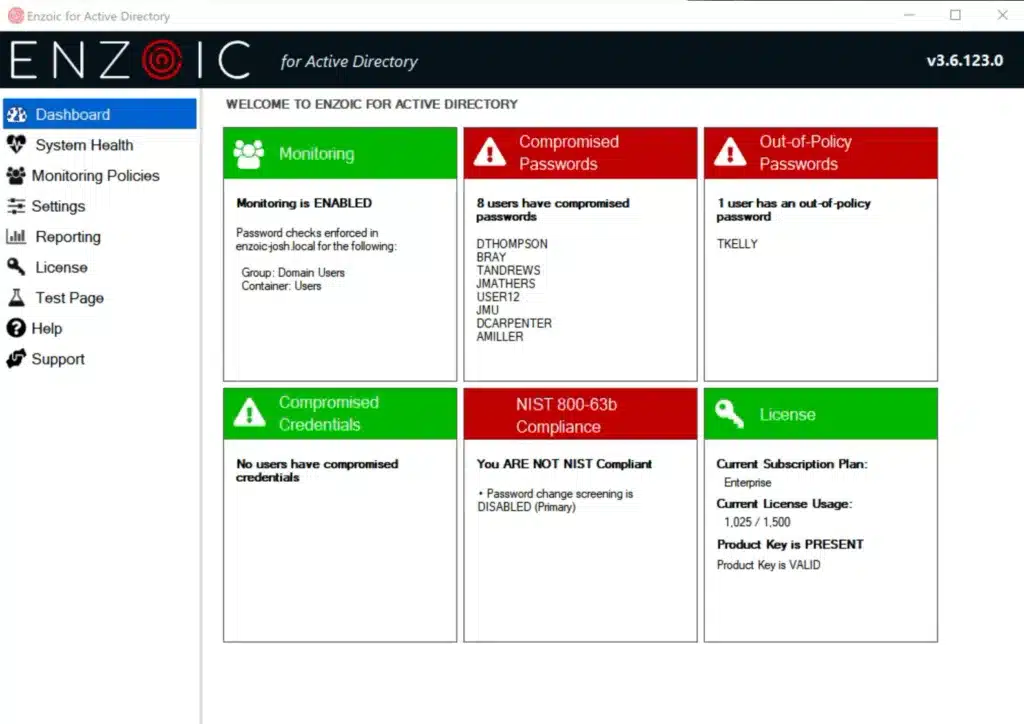
This is where Enzoic for Active Directory fits: it integrates with AD to validate passwords at the moment they’re chosen, block weak or previously compromised credentials, and continuously monitor for passwords that later appear in breach data.
That is the model modern AD environments need: keep native baselines, then add real-world credential intelligence and ongoing exposure monitoring.
Enzoic’s protection is powered by a continuously updated database of compromised credentials (from breaches, dark web sources, and malware logs) that is cleaned and deduplicated to keep detections current and actionable.
In practice, this approach focuses on:
- Blocking compromised/breached passwords at password set and change time
- Ongoing (for example, daily) checks for newly exposed passwords
- Going beyond simple complexity rules with options such as custom dictionaries, blocking username-derivatives, fuzzy matching for common substitutions, and detecting similar/root passwords
- Providing real-time user guidance during password change to reduce frustration when a password is rejected
When a newly compromised password is detected, admins can take targeted remediation actions such as forcing a password change at next logon, delaying that action, disabling an account, or running in notification-only mode. Logging and reporting can surface rejected password changes, compromise detections, and blocked attempts so admins can track outcomes.
A step-by-step path to continuous password defense
If you’re building a business case (or planning rollout), a simple sequence is:
- Measure current exposure. Run Enzoic for Active Directory Lite to see how many accounts are using compromised passwords, reused passwords, weak passwords, or even blank passwords.
- Remediate and prevent recurrence. Use Enzoic for Active Directory to block compromised passwords at set/change time, continuously monitor for new exposure, and drive targeted remediation instead of blanket resets.
That turns password risk from a general concern into something visible and measurable, which gives IT and security teams a much stronger way to justify investment in a real remediation project.
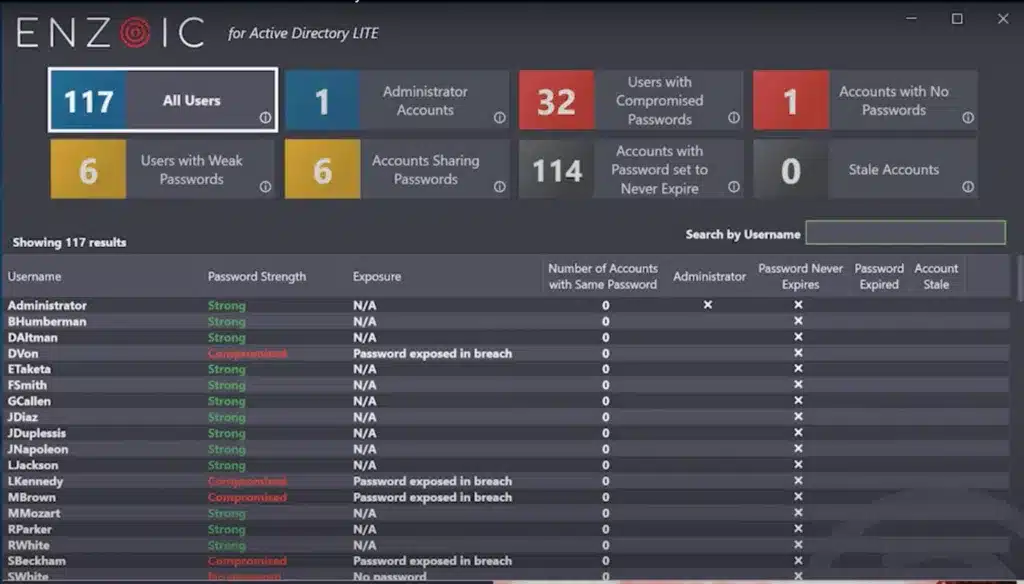
The outcome is a measurable password security posture: fewer compromised accounts, fewer risky password choices in the first place, and less time spent on avoidable resets and support tickets.
add a comment

What is Microsoft Agent 365?
What Is Microsoft Agent 365? Microsoft Agent 365 is a platform‑neutral control plane that treats AI agents as first‑class entities...
Microsoft 365 Backup: delegate administration, configure billing policies
Microsoft has launched departmental billing for Microsoft 365 Backup, effective March 2, 2026, enabling organizations to configure billing policies, delegate...
What is Microsoft Defender for Cloud Apps?
Microsoft Defender for Cloud Apps is a Cloud Access Security Broker (CASB) solution that delivers comprehensive security for Software as...
Azure DevOps Server 2022.2 Downloads
Azure DevOps Server allows you to self host the same modern dev services available in Azure DevOps, including Boards (planning and...