


394views
This one-day course is like you have worked for a company for at least 2 years as a Network Administrator, which you can put on your resume, because you will actually see each section in action with hands-on experiments, just as you would in a real environment. If you complete the 25 hours of hands-on experiments included in this class, I can assure you that it will be the equivalent of 2 years of experience in the field.
In the Windows Server 2022 Full Administration Course 100% Labs. You will be introduced to the full administration of Windows Server.
Table of Contents of the Windows Server 2022 Full Administration Course 100% Labs:
- Introduction to the entire course
- DNS and WireShark
- TCPIP classes, FLSM (Fixed Length Subnet Mask ) , Classful Networks
- TCPIP class subnetting, classless networks, VLSM (variable length subnet mask)
- Setting up the environment for DHCP, deleting previous settings
- Installing and configuring DHCP in Windows Server 2022
- Maintaining the DHCP server database
- Fault tolerance and performance for DHCP server
- Using Wireshark to capture DHCP traffic
- Setting up the environment for WSUS, removing previous lab settings
- Installing and configuring WSUS on a Windows Server 2022 upstream server
- Setting up a lab environment using VMware Player
- Configuring a downstream WSUS replica server
- Change WSUS server website from HTTP to HTTPS using SSL CA
- Setting up the environment for WDS, deleting previous settings
- Installing and configuring WDS on Server 2022, including requirements
- Client/server operating system deployment using unicast/multicast techniques using boot image
- Deploying W10/W11 operating system with applications, features, HotFixes and patches using a capture image
- Setting up the environment for AD, removing previous settings (2 W2019 and 2 W10)
- Installing Active Directory on multiple Windows Server 2019 for redundancy
- Difference between first and second server, GCDCDNSFSMO, including replication
- FSMO roles
- Setting up a lab using HyperV
- Remove Active Directory, demote DC/GC
- Return AD to the first server to continue
- RODC
- Demotion of both DCs
- Reinstalling AD on Server 1 the correct way
- Active Directory Users and Computers, Users, Computers, Groups, OUs ( graphical interface )
- Active Directory Users and Computers, Users, Computers, Groups, OUs (using CLI)
- How to manage and control AD from a client device (RSAT)
- Active Directory database maintenance
- Working with Active Directory Administration Center
- Setting up a lab using VirtualBox
- Active Directory domains and trusts
- Active Directory Sites and Services
- Integration with Windows Server 2022
- Setting up the environment for GPOs (1 W2022, 1 W10, 1 W11), removing previous settings
- Setting up AD on the server and joining computers to the domain
- Setup to prepare for working with GPMC (Group Policy Management Console)
- Working with GPMC at the domain level
- Working with GPMC at the OU level
- Software deployment via GPOs
- Backup and restore GPOs
- Preparing the environment for DNS (one Server 2022 and two Windows 10 computers)
- Preparing the environment for the Certificate Authority (CA), removing previous settings
- reparing the environment for the file server, working with previous settings
- Final notes
- Install and configure DNS in Windows Server 2022 and manage both client computers
- Setting up a lab for 2 different companies to see how DNS works
- DNS integration into Active Directory, you need all 3 servers and 2 clients
- The Hosts file and its relationship to queries
Download links
Size : 10120 MB
add a comment

How to Block Control Panel & PC Settings for Domain Users Using Group Policy on Windows Server 2025
Introduction One of the most overlooked — yet critically important — aspects of managing a Windows domain environment is controlling what end users can actually access on their own machines. Left unconfigured, any domain user can wander into Control Panel or PC Settings and make changes that can break network configurations, modify security baselines, or simply waste IT support hours chasing self-inflicted problems. With Group Policy in Windows Server 2025, you can lock this down in minutes. By pushing a single GPO to your domain users, you can completely hide...
How to Remotely Remove (Disjoin) a Client Computer from Domain in Windows Server 2025
Introduction Managing Active Directory environments often means handling machines you cannot physically reach — a remote office workstation, a laptop across the country, or a decommissioned VM sitting in a data center rack. Knowing how to remotely disjoin a computer from a Windows Server 2025 domain is an essential sysadmin skill that saves time, reduces travel overhead, and keeps your AD environment clean and secure. In this guide, you will learn multiple methods to remotely remove a client computer from your domain — without ever touching the machine — using...
How To Block Domain Users From Access Folder Options Using Group Policy in Windows Server 2025
Introduction If you manage a Windows Server 2025 environment, you already know how quickly things can go sideways when users start tinkering with settings they shouldn't touch. Folder Options in File Explorer is one of those deceptively simple menu items that lets users reveal hidden files, change file associations, and toggle system-critical display settings — changes that can expose sensitive data or break standardized desktop configurations across your entire domain. The good news? You don't need third-party tools or complex scripts to handle this. Windows Server 2025 Group Policy gives...
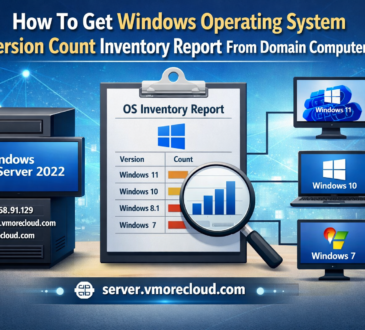
How To Get Windows Operating System Version Count Inventory Report From Domain Computers
In enterprise environments, keeping track of the operating system versions deployed across domain-joined machines is a fundamental IT hygiene and...